A work explained · September 7, 2026
What makes AI science explanations work? Start with bicycle gears
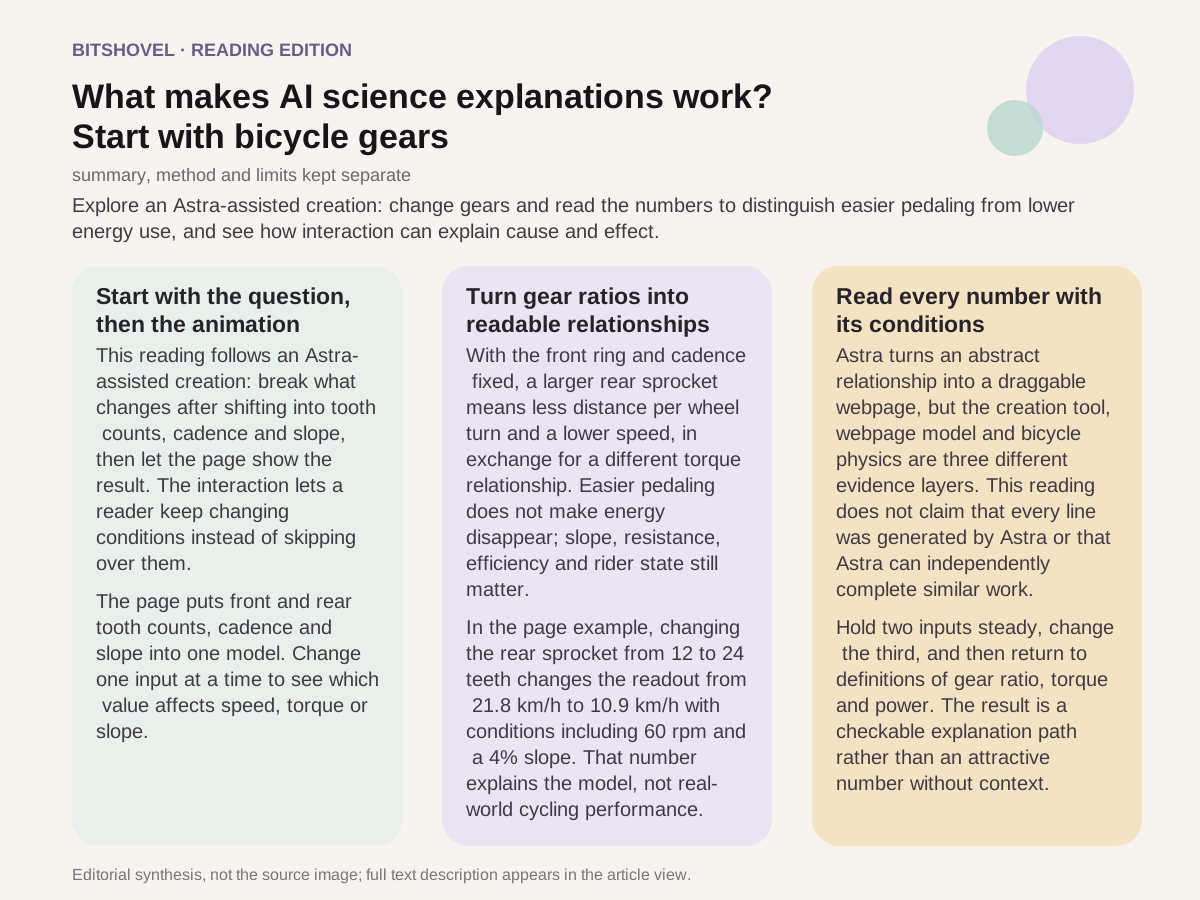
Explore an Astra-assisted creation: change gears and read the numbers to distinguish easier pedaling from lower energy use, and see how interaction can explain cause and effect.
01Start with a puzzle中文
What does an explanation need beyond motion?
A gear change can make a climb feel easier. But should the larger sprocket be at the front or the rear? And does needing less force also mean using less energy? These questions give a spinning animation something concrete to explain.
V2EX author int64ago described building vistep with Astra. Following that lead, we explored its bicycle-gearing work. The current page offers a chaptered demonstration and controls for tooth counts, cadence and gradient. We will use it for a few comparisons, alongside a smaller experiment that isolates the drive ratio.
The author’s account of tool use does not establish that every part of the current page was produced independently by the model. We examine how one work explains a mechanism, without measuring learning outcomes or rating Astra’s overall teaching ability.
Sources and further reading
- Open the bicycle experimentvistep · interactive workAfter loading, choose Explore to adjust gearing, cadence and gradient.
- The author’s build postV2EX · 2026-09-06The account of using Astra, without attributing every implementation detail to it.
02Count revolutions中文
The same chain travel, a different number of turns
Imagine 34 positions around the front chainring. Advancing one tooth moves the chain by one pitch, so a full front revolution advances 34 pitches. A 12-tooth rear sprocket turns 34÷12 times to receive that chain; a 24-tooth sprocket turns 34÷24 times. This assumes no slip and a rear wheel engaged with the drive.
With the front chainring fixed, a larger rear sprocket gives fewer wheel turns per crank turn. At the same cadence, the bicycle travels more slowly. To explain what a larger sprocket does, first specify which end it is on and what stays constant.
Sources and further reading
- Exploratorium · Drives & GearsScience-museum teaching materialExplains the rotation ratio by counting teeth.
Keep a 34-tooth chainring and a 10 N·m torque demand at the wheel. Predict: will a larger rear sprocket make the crank easier to turn?
34 ÷ 24 = 1.42; crank torque = 10 × gear ratio.
A larger rear sprocket requires more crank turns for the same wheel rotation, with less crank torque. Fixing the wheel load isolates the effect of the gear ratio.
Our ideal-drive calculation assumes no slip or losses. The 10 N·m load is a teaching choice. It does not model a road, air resistance or a rider, and is not a measurement from the work below.
03Then examine effort中文
Less torque, more turns
Torque describes a force’s turning effect. Hold the wheel’s torque demand fixed and ignore drive losses: the mechanical work for one wheel revolution is unchanged. Distribute that work over more crank turns and less crank torque is needed. The small experiment changes turns and torque together, without creating energy.
Changing from 34/12 to 34/24 doubles the rear tooth count. At the same wheel load, required crank torque halves, while the crank must turn twice as often for the same wheel rotation. With the same crank length and force direction, lower torque corresponds to lower tangential pedal force.
Reaching the same height still increases gravitational potential energy according to mass and height. Real cycling also involves speed, air resistance, losses and human efficiency. A low gear can ease each pedal stroke without implying an equal proportional reduction in total energy use.
Sources and further reading
- OpenStax · Work and Power for Rotational MotionPhysics textbookRotational work and power; our small experiment applies idealized conditions.
04Return to the work中文
When a number changes, ask what else changed
Open vistep’s Explore mode and reset. Keep the 34-tooth chainring, 60 rpm cadence and 4% gradient, changing only the rear sprocket. On September 7, desktop Chrome displayed the three results below. They are rounded outputs of the webpage’s model, not measurements from a bicycle sensor.
From 12 to 24 teeth, speed approximately halves, but pedal force does not halve exactly. That need not indicate an incorrect ratio: the webpage also computes air resistance from speed, so lower speed reduces the load. It combines gearing with road load, while our earlier experiment holds the load fixed to answer a simpler question.
Sources and further reading
- Inspect the work’s calculationAuthor’s source · pinned revisionSpeed feeds into air resistance, then wheel torque, crank torque and pedal force.
- 12 rear teeth
21.8 km/h
266 N · equivalent pedal force
- 24 rear teeth
10.9 km/h
113 N · equivalent pedal force
- 32 rear teeth
8.2 km/h
83 N · equivalent pedal force
Observed on vistep, 2026-09-07: 34 front teeth, 60 rpm and 4% gradient. The page fixes total mass at 80 kg, wheel radius at 0.34 m and drive efficiency at 96%.
05Make a prediction中文
Predict the result before moving a control
Try two more observations. Hold 34/32 gearing and 60 rpm, raising the gradient from 4% to 8%. In our observation, speed stayed at 8.2 km/h while pedal force rose from 83 N to 152 N. The model asks how much force is required to maintain the specified speed; a steeper road does not automatically slow its readout. A real rider may instead be unable to maintain cadence.
Then keep the gearing and 8% gradient, increasing cadence from 60 to 100 rpm. We observed an unchanged ratio of 1.06, speed rising to 13.6 km/h and required power increasing from 162 W to 279 W. Gearing sets the ratio of rotations; cadence sets their pace. These are different controls.
This suggests a reusable method for making explanations with AI: state the causal relationship, let readers change one input at a time, and make the image, numbers and explanation respond to the same change. When a prediction differs, explain the missing condition. Each control should have a clear question to answer.
Afterward, ask yourself why a larger front chainring differs from a larger rear sprocket, and why the model can keep its speed when the gradient increases. Explaining those points uses the relationships behind the picture, beyond memorizing a number.
Sources and further reading
- Continue exploring the originalvistep · browser experimentWe checked selected desktop interactions and pinned formulas, without evaluating the whole site, narration or learning outcomes.
See how these changes connect
 Topic · Following
From a standalone interactive work to an operable chat answer: see the new product entry point.
 Topic · Following
Continue from bicycle gears to a motorcycle atlas built from existing manuals.
OpenMAIC offers another way to make material understandable: an interactive course that can be revised.