
01 / ANALYSIS
Product analysis
- Maturity
- Commercial
- Confidence
- Partial
- Verified
- 2026-07-19
- Commercial relation
- Not sponsored
Problem solved
Moving from Teams or Google Chat to Slack requires preserving identity, channel permissions, threads, DMs, files, timestamps, and context—not merely copying messages—and finding gaps before cutover.
Why it was selected
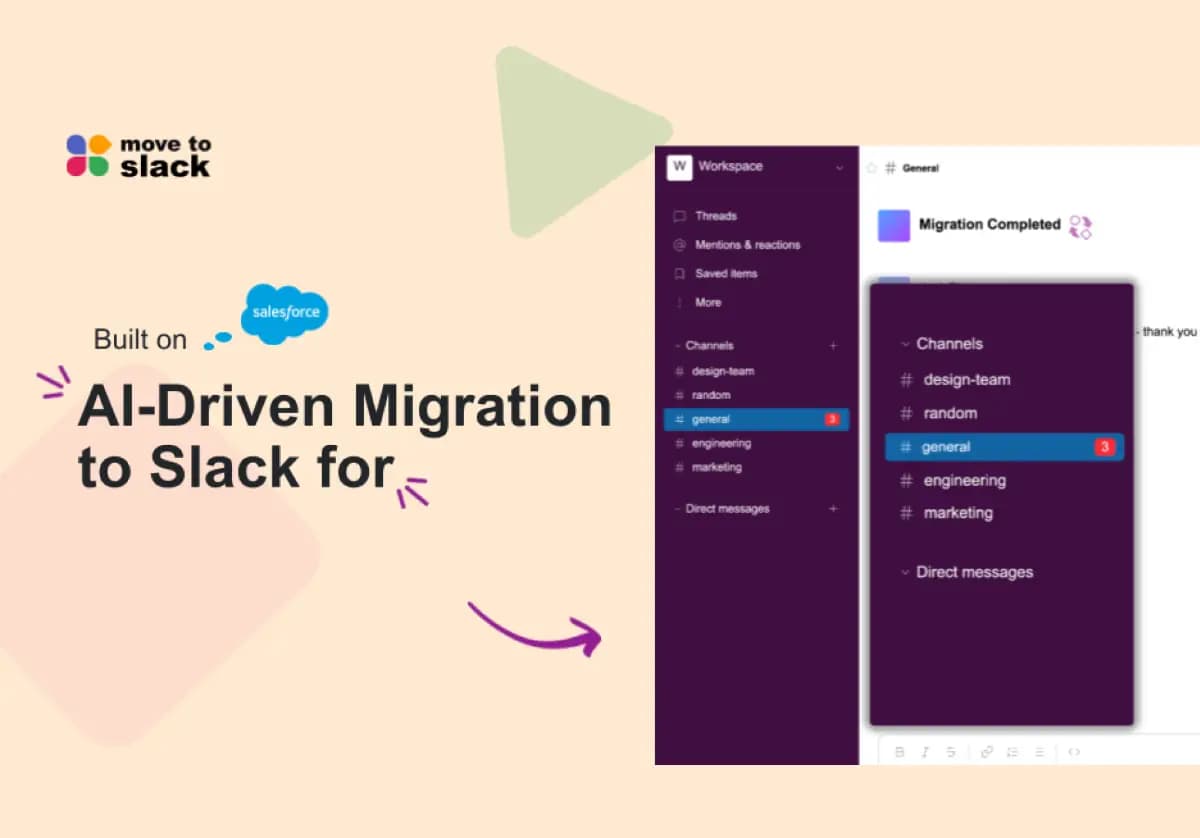
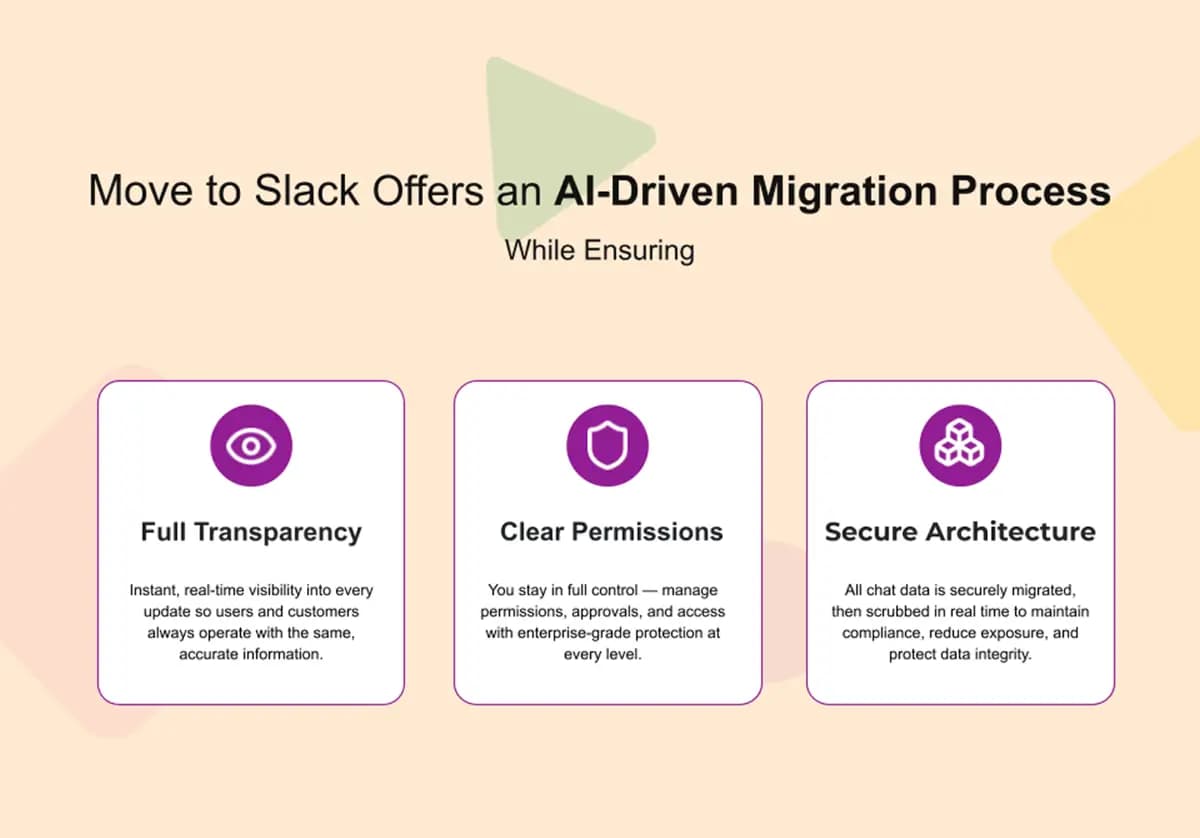
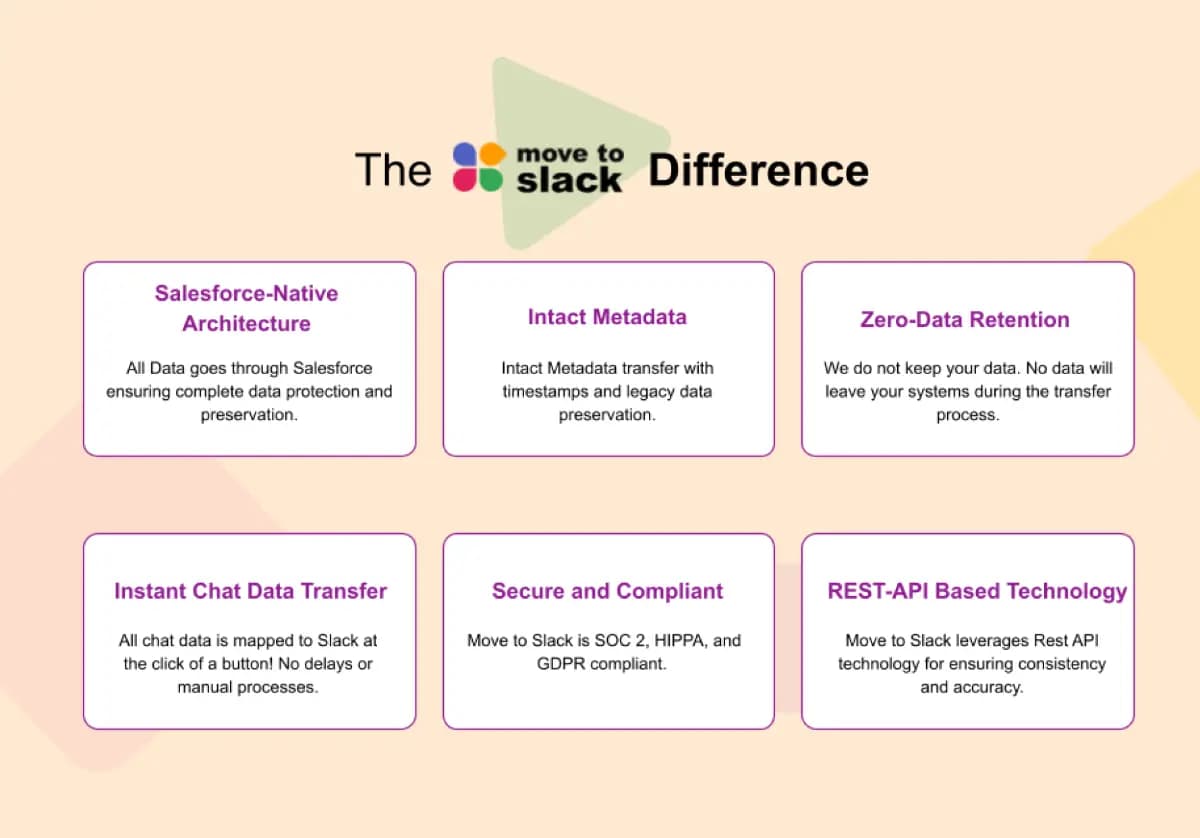
The first publisher original places Salesforce, a source platform, a Slack workspace, and completion state in one product-specific graphic, with a progress panel for users, channels, messages, files, threads, and timestamps. The other two maker originals collect claims about transparency, permissions, architecture, metadata, zero retention, and compliance. It is useful for studying how an enterprise migration product makes risky back-office work legible—and for checking whether marketing maps to permissions, data flow, and contracts. All three are exact current maker uploads from Uneed: the first includes an interface presentation, while the latter two are official explanatory graphics. They do not prove a real migration, customer counts, accuracy, security, or compliance.
What is genuinely novel
Chat migration, OAuth, mapping, and validation reports are established patterns. The transferable value is combining planning, background transfer, and final acceptance in one visible workflow. 'Salesforce-native' and 'AI-driven' remain maker claims: public pages do not identify the Salesforce objects and execution boundary, AI model, inputs and outputs, or human review points.
Best for
IT administrators comparing Teams or Google Chat migration paths who can first run permission and vendor-security review; not for an informal trial on a real workspace, and not for treating Slack-to-Slack as currently available
Editorial evaluation
KEEP DISCOVERING
A few more products worth noticing
A small set selected by product shape and profile similarity, with independent verification records.
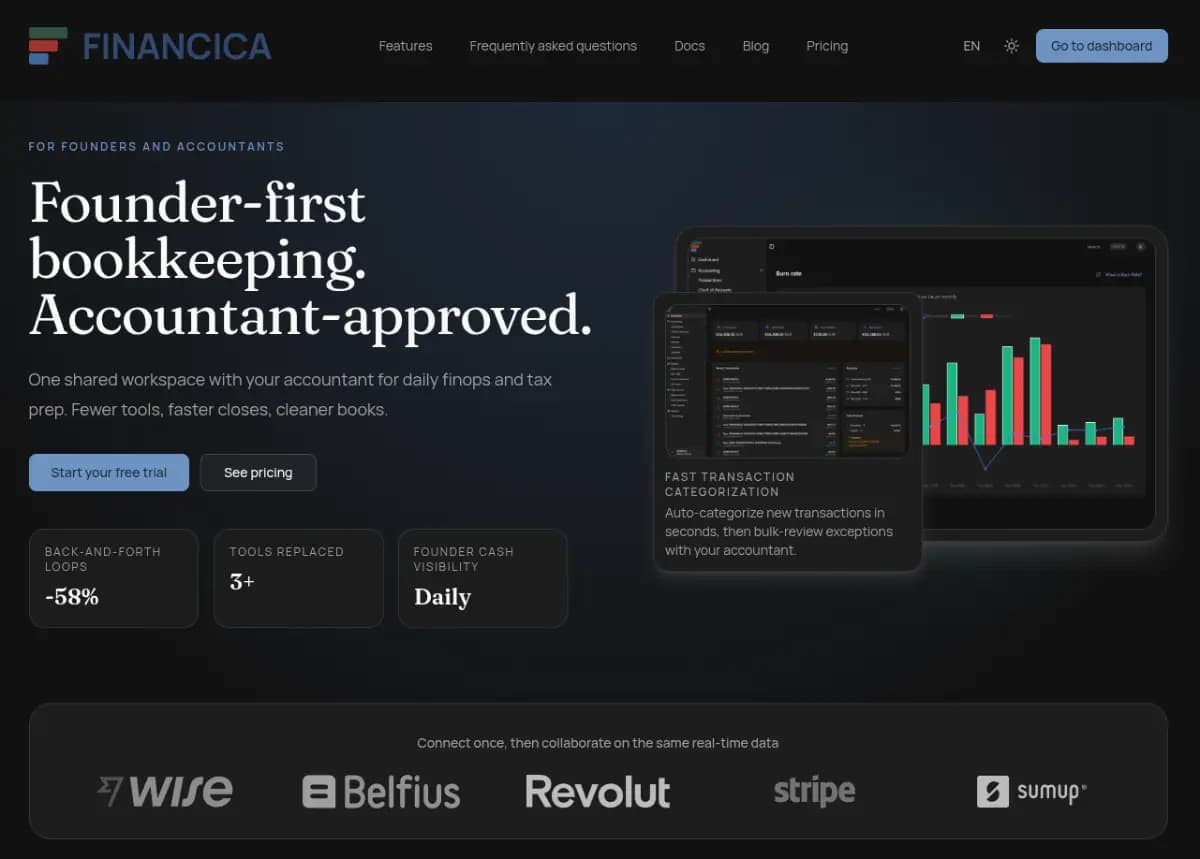
Financica
Uneed publisher Jerome Leclanche (@jleclanche) / operator Ingram Technologies SRL
What it solves
Small companies often split bank feeds, Stripe, invoices, receipts, VAT worksheets, cash forecasts, and accountant communication across tools and email. Month-end then requires re-exporting, re-explaining, and reconciling, while founders work from delayed numbers.

Typer AI
Satellite Studio (Duarte Design Studio AB)
What it solves
People may want private local models but still get blocked by model files, quantization choices, memory requirements, and runner setup. Typer provides an immediately usable compact model on Apple-silicon Macs, then recommends a better download for the device and includes limited web search in the same chat interface.
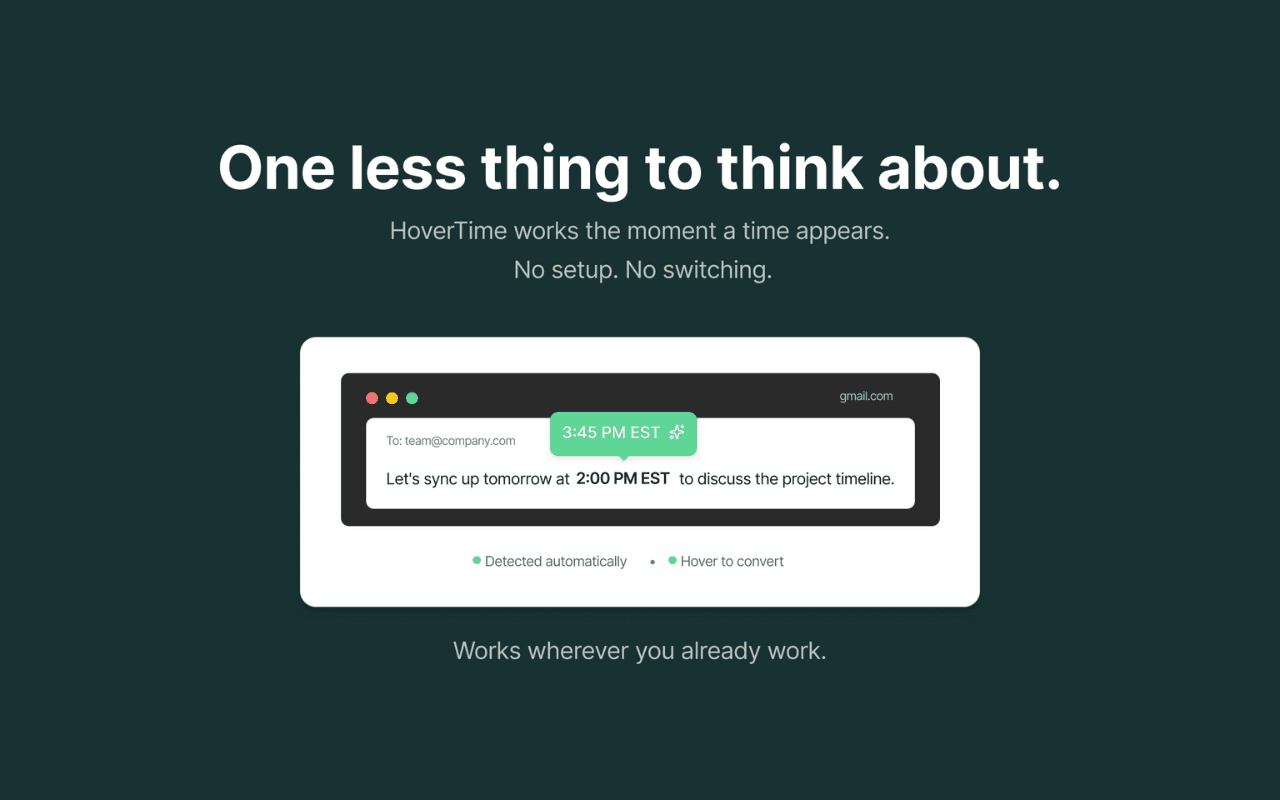
HoverTime
Seconds Labs LLC
What it solves
Cross-region work repeatedly exposes people to PST, CET, and city-based times inside messages and meeting details, interrupting the task with searches or mental math. HoverTime detects time expressions on supported browser pages and shows the local conversion on hover.
02 / WHAT STANDS OUT
Three product decisions worth noticing
Generate scopes by migration phase
List source and destination scopes separately for discovery, dry run, transfer, validation, and cleanup, generating the smallest bundle by default. Before consent, show rationale, duration, and revocation, and automatically compare the actual consent screen with public documentation.
Make zero retention an acceptance state
Map every data class across the source, execution plane, staging, logs, backups, and destination Slack, with a TTL at each node. On completion, give the customer a signed manifest for deletion jobs, failures, backup expiry, and token revocation.
Use one fact table for availability and metrics
Version source platforms, data types, availability, pricing, metric definitions, sample sizes, and audit links in one manifest that generates the site, directory submissions, and sales collateral. This prevents coming-soon support, free labels, and unlike success denominators from blurring together.
Product insight worth carrying forward
Have administrators review user, channel, DM, file, and date-range mappings before asynchronous execution, then accept the result through a gap report. Make preview, approval, migration, validation, and cutover explicit states instead of one irreversible import.
03 / DO NOT COPY
What not to copy
04 / LIMITS & RISKS
Limits and risks
The largest gap is permission scope. The process page says Teams or Google Chat is connected with read-only API access. Yet the Google admin setup publishes scopes for message and space creation/deletion, writable admin directory access, `cloud-platform`, BigQuery, full-control Cloud Storage, Datastore, Logging, Monitoring, and Trace, with duplicated BigQuery entries. The MS Teams page likewise lists application-wide organizational reads alongside delegated app-registration writes, channel deletion, message and chat writes, file writes, SharePoint full control, and group/member writes. It does not identify which scopes the current product actually requests, which belong to source versus destination, why each is needed by migration phase, what can be removed, the least-privilege bundles, or token storage, rotation, revocation, and admin audit. 'Read-only' therefore is not supported by the current public setup material. The data boundary is also incomplete. Home says no local server storage and zero retention; the process says no data retained beyond the migration window; the introduction only says no external-server storage after migration. The second maker graphic says data is scrubbed after transfer, while the third says no data leaves customer systems. None defines the migration window, transient location, whether Salesforce counts as vendor infrastructure, how attachments travel, how long retries, logs, backups, validation reports, and tokens persist, or what deletion evidence customers receive. The privacy policy defines the Service as the Website and generically covers contact data, addresses, Usage Data, cookies, marketing, international processing, and retention as necessary. It does not cover source messages, DMs, files, directories, OAuth secrets, mappings, migration logs, failures, processors, regions, encryption, incident notice, a DPA, or concrete deletion periods. The terms likewise primarily govern website access, without migration scope, SLA, data processing, security schedule, backup/recovery, refund, or acceptance terms. Published marketing metrics lack methods: the hero combines 2,800+ workspaces with 99.98% data-match accuracy, while the footer says 1M+ messages, 500+ teams, and 99.9% success. Workspace/team and data-match/success may be distinct, but no sample, period, denominator, or independent evidence is supplied. Compliance language also drifts: Home says SOC 2 and HIPAA-aligned, the introduction says GDPR, SOC2, and HIPAA aligned, and the maker graphic says SOC 2, misspells HIPAA as HIPPA, and says GDPR compliant. No report, audit scope, issuer, BAA, DPA, region, or control mapping was found. Uneed labels pricing Free, while the official site only offers a sales call and publishes no price, trial, license, or Salesforce/Slack plan prerequisites; free use is therefore unverified. Salesforce-native architecture, real-time sync, zero downtime, complete migration, 99.98% matching, 500+ teams, and 2,800+ workspaces are team statements. We found no customer case, reproducible test, public app manifest, or contract material to independently establish them.
Compared with alternatives
Compared with Slack's native import paths and one-off scripts, it presents mapping, background execution, live status, and pre-cutover validation. Compared with mature enterprise migration services, it currently lacks a verifiable permission matrix, data flow, migration-specific processing terms, public pricing, audit material, and customer evidence. The workflow is worth studying; procurement evidence is not yet sufficient.
05 / EVIDENCE
Visual evidence
06 / SOURCE
Source and verification
- Original author
- Uneed publisher signmadeasy / the HIC Global Solutions team
- Country / region
- United States (company registration address)
- Maturity
- Commercial
- Confidence
- Partial
- Discovered
- 2026-07-19
- Last verified
- 2026-07-19
What this review checked
This was a read-only review of the current Uneed launch, publisher identity, three maker originals, and live site, plus the five-stage process, Google Chat and MS Teams connected-app setup, three consent guides, privacy policy, December 30, 2025 terms, introduction post, and the public parent-product entry for MultiSync Made Easy. The site labels MS Teams and Google Chat live and Slack-to-Slack coming soon. Its primary entry is a Calendly call with a migration expert; no public self-service console or price was found. We did not create an account, book a call, subscribe, configure an OAuth client, generate credentials, grant admin consent, authorize Google, Microsoft, or Slack, connect a workspace, read messages, export files, run a migration, validate results, contact sales, or pay. Runtime behavior, requested permissions, data path, retention, performance, support, and commercial terms remain independently untested.
Latest change
Initial profile created from the current Uneed launch, publisher identity, three exact maker originals, live site, five-stage process, Google Chat and MS Teams connected-app setup, three consent guides, privacy, terms, introduction post, and parent-product entry. No registration, booking, subscription, OAuth credential, workspace authorization, chat read or migration, sales contact, or payment occurred. Current platform availability, permissions, data flow, zero retention, pricing, marketing metrics, compliance, and contract boundaries are recorded.
Ready to explore further?
Open the product, or return to the original source to verify the details.
ONE-TAP FEEDBACK
Did this profile help you judge the product?
One tap. No writing required.