Baoyu · public author updates · Published 2026-07-29
How Baoyu uses coding agents: define the feature, delegate implementation
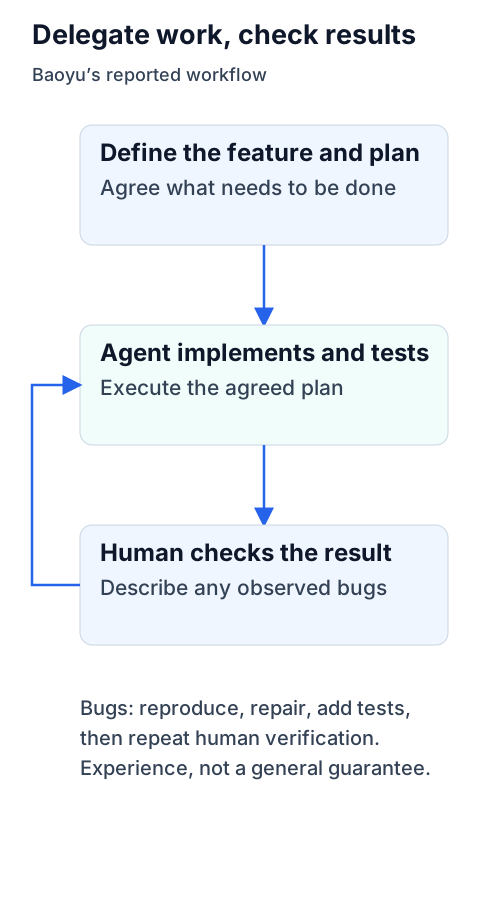
In a July 29 post, Baoyu describes defining features, agreeing on a plan with an agent, delegating implementation and tests, then accepting the result. BaoCut provides the examples; planning its next version still became a bottleneck.
Keep responsibility for goals and acceptance
Baoyu reports moving away from close code-level supervision toward choosing features and validating completed behavior. Bugs return to the agent for reproduction, repair and related tests, followed by another human check.
A useful takeaway is to make expected behavior explicit and compare it with the result. This is our interpretation; the appropriate level of code review still depends on the project and what its owner can verify.
Choose technology for the project
For a subtitle-translation app, the author moved from familiar Electron tooling to Swift and AppKit after dissatisfaction with performance. He later chose Rust for a cross-platform BaoCut version and reports completing an initial version despite no prior Rust coding experience.
He also reports a period of daily small releases, slowing when larger-version planning needed more thought. This is a creator self-report, not proof of general time savings, defect reduction or equivalent results for other developers.
Important additions and corrections
Dates below mark changes to our coverage.
- Addition ·
Added the source date, BaoCut technology choices, feature acceptance and bug-repair process.
Sources and notes
sources中文
Sources and notes
- Read the originalBaoyu · public author updates
Retained summary and context
This is a creator self-report, not proof from an independent productivity test. Iteration speed and technology choices do not generalize automatically; human acceptance criteria still matter.
Sources and evidence · 1 link
Each link has a purpose and scope. Link counts do not establish independent confirmation; direct support applies only to the statements specified below.
Source timeline
- · The author published a full loop: choose the feature, co-write the plan, let the agent implement and test, validate it, then repair regressions.
- · The author’s public updates returned 50 entries. BitShovel retained only the latest 20 titles, links, dates, and author fields; two checks found no new or metadata-updated entries, so no duplicate information card was created.
Collection record
First discovered:
Collection and source publication have distinct dates.
Editorial record
Sources reviewed
· Beijing time (UTC+8)
Added the source date, BaoCut technology choices, feature acceptance and bug-repair process. Event, discovery and collection dates remain unchanged.
Sources and full record
This dates our review of the wording and sources, not a project release or product update.
Full record: before, after and sources (JSON)See how these changes connect
As code output grows, what must people still understand, review and maintain?