
01
Transcript-based cutting worked
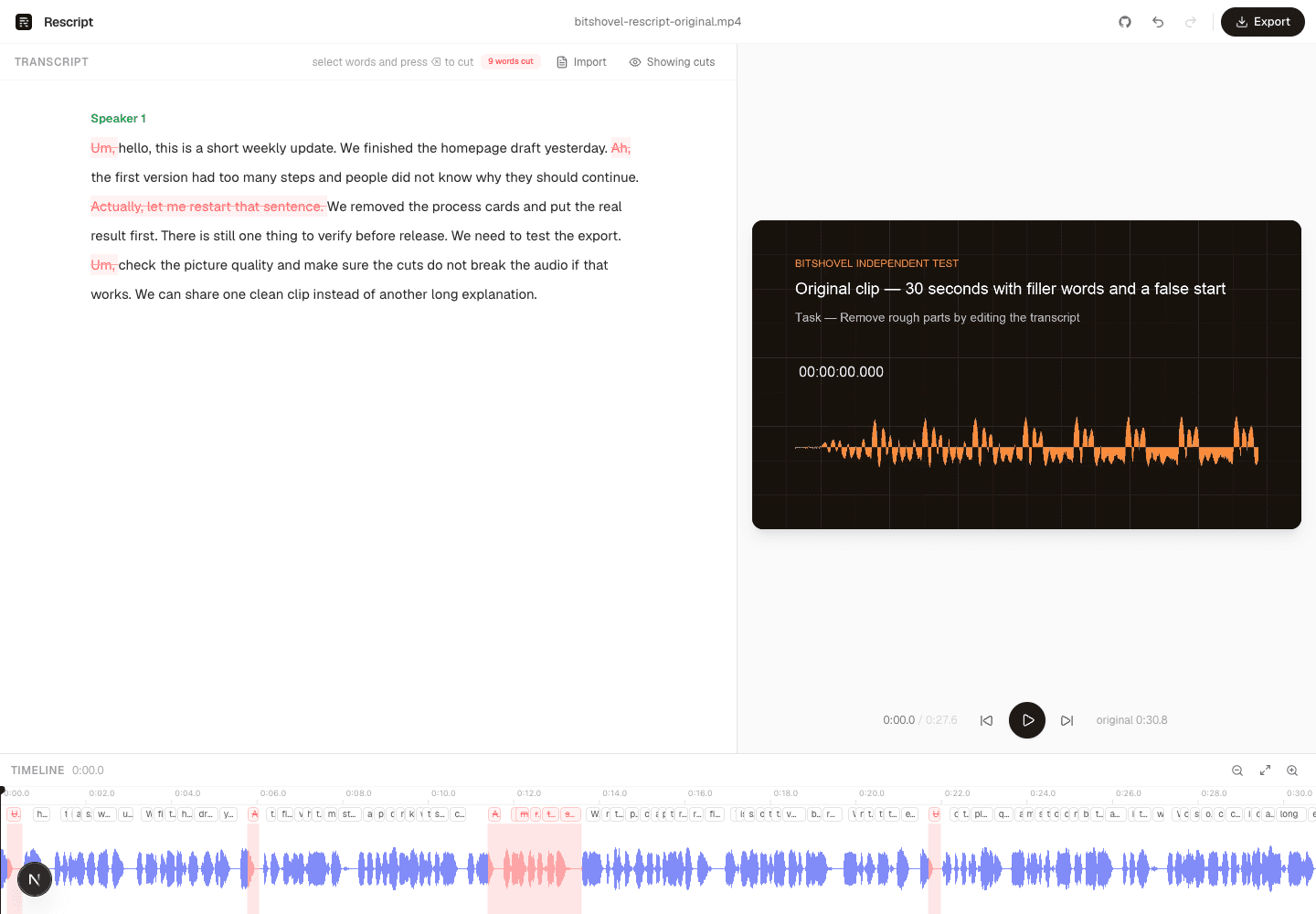
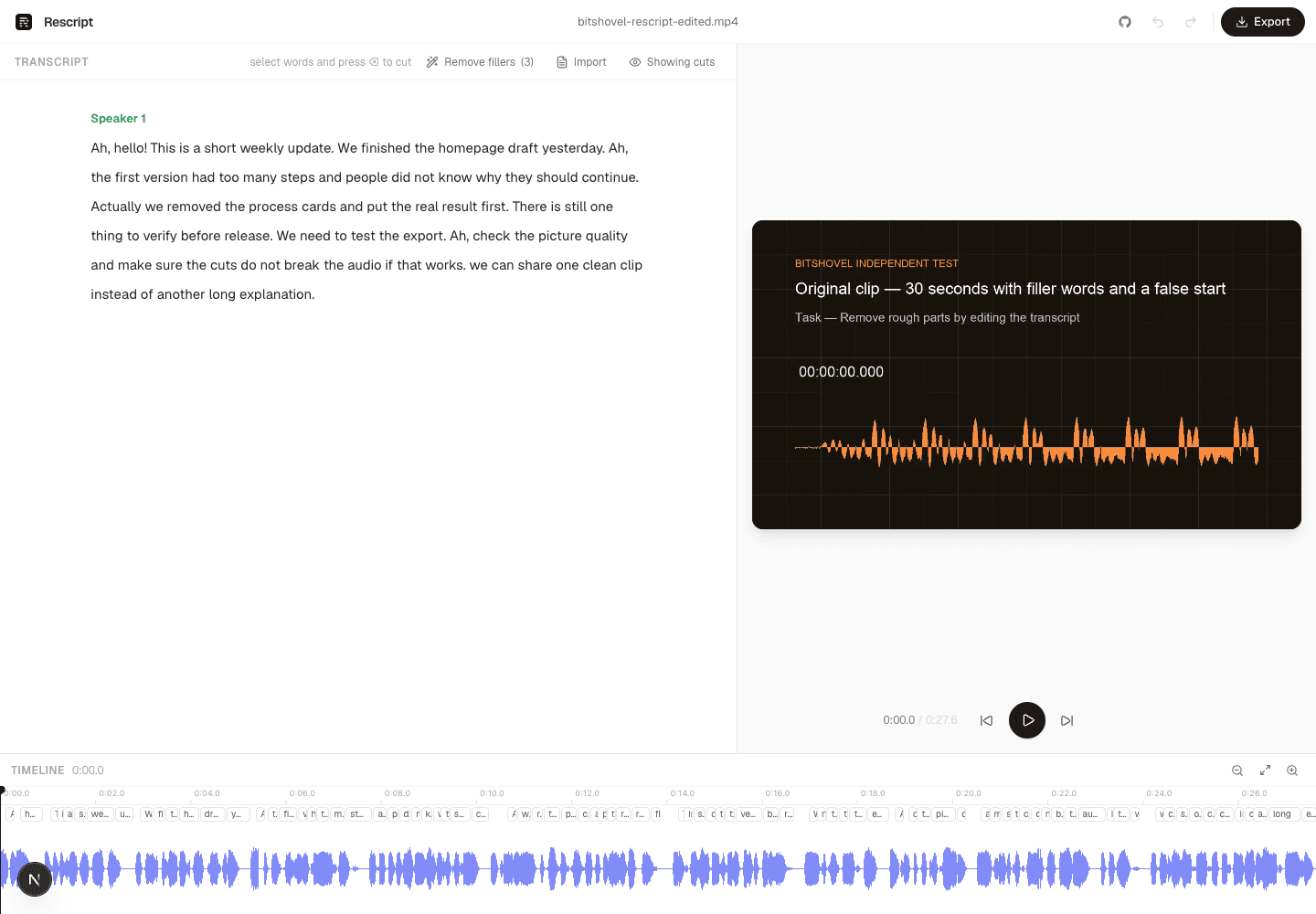
The interface reported Remove fillers (3). After the one-click filler action, 6 false-start words were selected manually, producing 9 marked words and 4 cut ranges. The edited timeline showed 27.6 seconds.
Transcript-based video editing
In a local build of an exact commit from Rescript's official repository, a 30.77-second self-made English sample marked 3 filler words and 6 false-start words in the transcript, producing 4 cut ranges and a 27.64-second MP4. Project recovery and cached offline re-export worked, but a fresh offline transcription failed and the exported media still requires manual listening.
1280×720 / 30fps
4 cut ranges
Observed ≤5.1s
Compared with original
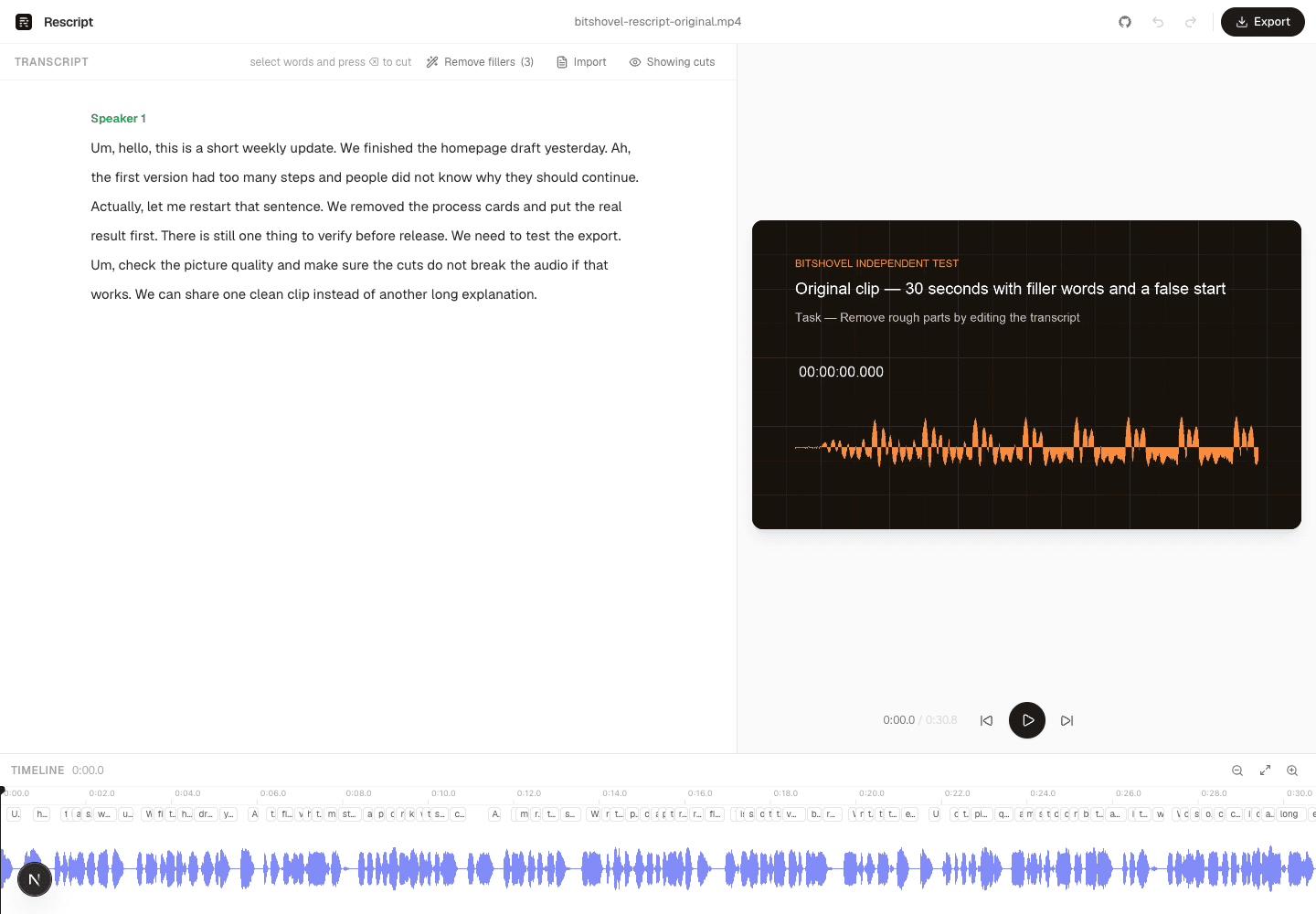
The left image shows the original state after Whisper Base transcription. The right shows the interface after 3 fillers were marked in one click and 6 false-start words were selected manually. The pair proves that the edit state and cut ranges changed, not that every word completely disappeared from the audio.
When the export was transcribed again with the same Whisper Base model, three positions were still recognized as “Ah” and “Actually” still appeared. Because the same model judged both passes, this is not an independent comparison and does not prove degraded audio, failed cuts, or transcription accuracy. It is only a warning to listen to every edited position manually.
4 cut ranges
Original 30.77s
Compared with original
02 / WHAT ACTUALLY WORKED
Screenshots, media parameters, and recovery checks show how far the workflow got. They do not replace listening to every edited position.
The interface reported Remove fillers (3). After the one-click filler action, 6 false-start words were selected manually, producing 9 marked words and 4 cut ranges. The edited timeline showed 27.6 seconds.
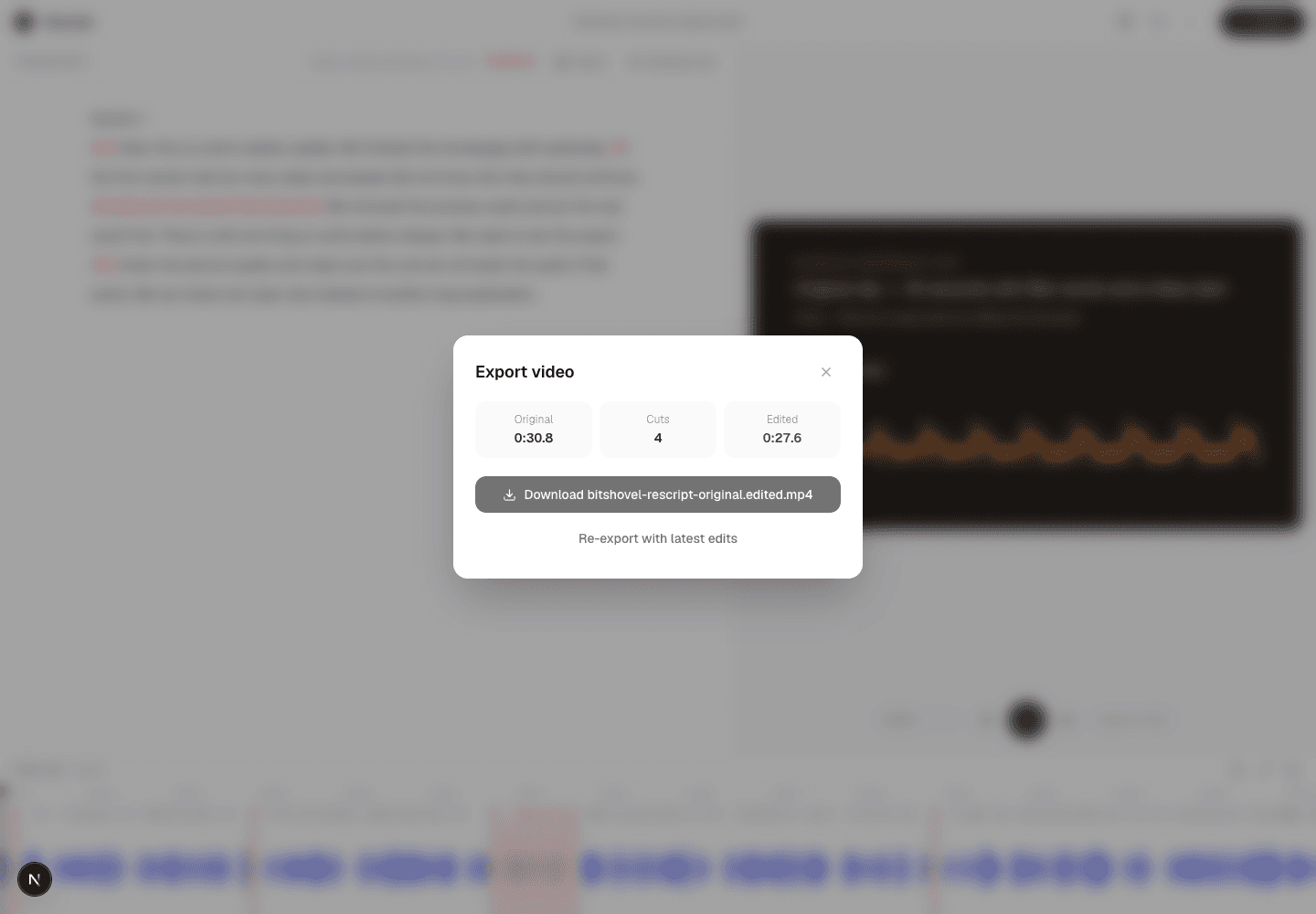
Export completed within the observed 5.1-second window. The 27.64-second, 1280×720, 30fps H.264/AAC MP4 decoded fully and showed no visible watermark. At 10,338,087 bytes, it was 2.237 times the original file size.
The project remained after refresh. With the model and project already cached, an offline re-export completed in 2.452 seconds. A fresh offline transcription failed, so this is not a first-run fully-offline result.
This test covered only a local build of official repository commit 63fa992272d69e4fc3cf6a5ce49ca658cbafde89. No media was uploaded to or processed in the public GitHub Pages version. The public GitHub Pages build was not tested. Local-build results must not be presented as results from the live surface.
03 / EXPORTED RESULT
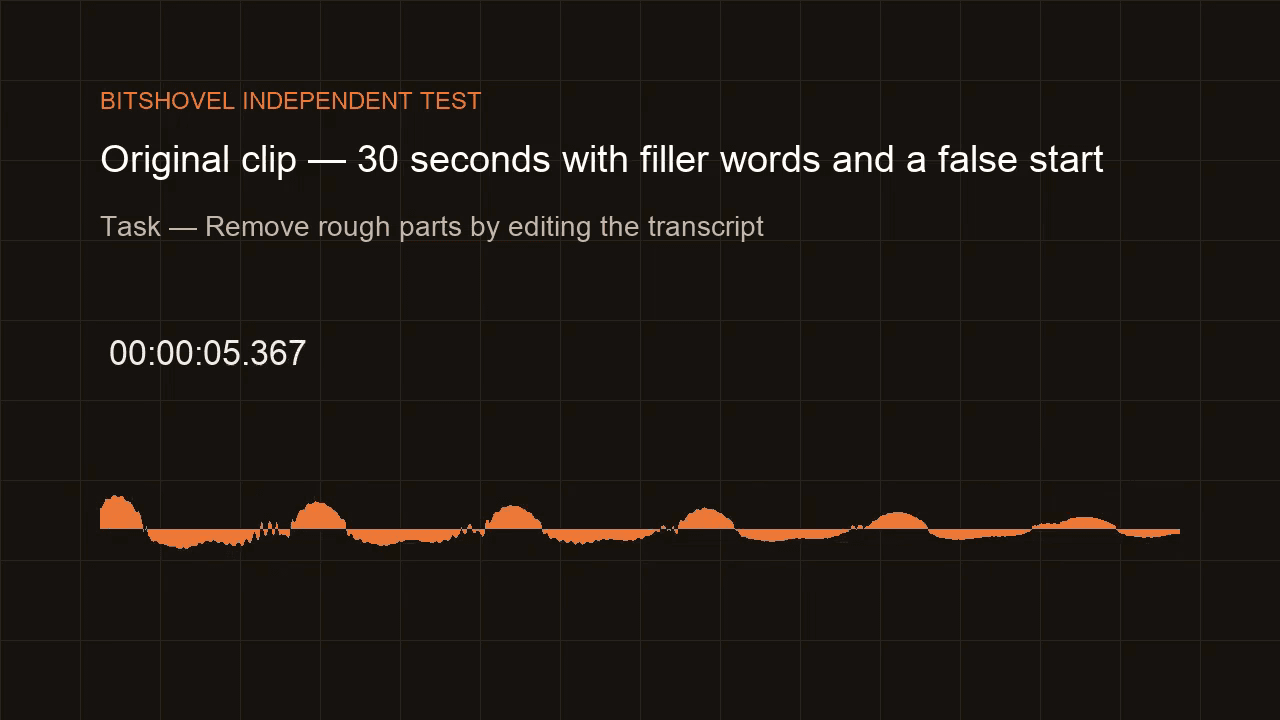
This MP4 decoded fully and showed no visible watermark, but audio was re-encoded as AAC 22050 Hz mono and the file grew to 2.237 times the original size.
04 / MANUAL LISTENING REQUIRED
When the export was transcribed again with the same Whisper Base model, three positions were still recognized as “Ah” and “Actually” still appeared. Because the same model judged both passes, this is not an independent comparison and does not prove degraded audio, failed cuts, or transcription accuracy. It is only a warning to listen to every edited position manually.
Do not read this image as proof that automatic removal failed—or that it was accurate. Whisper Base judged both passes, so this is only a risk signal that requires manual listening.
05 / IS IT A FIT?
This result supports one narrow use case. It does not generalize to every language, duration, or delivery requirement.
06 / LIMITS PROMOTION CAN MISS
Only a 30.77-second self-made English sample was tested; Chinese, long videos, multiple speakers, complex background audio, and real meetings were not tested.
A cached offline re-export does not establish first-run offline use or a complete audit of media-related network requests.
No visible watermark was observed in this export only; other formats, settings, and future versions were not tested.
The export used AAC 22050 Hz mono and was 2.237 times the original file size. No independent perceptual, audio-quality, or synchronization measurement was completed.
The README says MIT, but the exact-commit checkout has no LICENSE file; it also uses @ffmpeg/core-mt, whose package metadata says GPL-2.0-or-later. The overall licensing boundary still needs review.
07 / MINIMUM-COST TRY
Do not begin with meetings, client work, or unpublished material. Use a disposable 20–30-second self-made clip containing one filler and one false start you intend to remove.
Record the exact commit or live version, browser, model, first-download time, and network state.
Remove only one filler and one false start, and confirm that matching cut ranges appear.
Play the export from start to finish and listen closely at every cut. Do not substitute same-model retranscription for manual review.
Compare duration, resolution, audio parameters, file size, sync, watermark, and recovery after refresh. Stop if any critical result is unacceptable.
If you still choose to try it, use only a disposable, non-sensitive clip you made yourself. Complete the minimum test above before using meetings, client work, or unpublished media.
08 / ORIGINAL SOURCES
Maker claims, BitShovel's local observations, and unresolved items are kept separate. Open the original pages to verify them yourself.