Models and research · Give proposals checkable feedback
How do we judge whether an AI-designed quantum circuit uses less?
One decoder’s resource reduction shows how model proposals, programmatic checks and proofs work together. Fewer gates and qubits differ from a measured hardware speedup.
The preprint was submitted October 15 UTC (October 16 in Beijing); Anthropic’s post is dated October 16. This reading checks the paper, pinned code and proof documentation on October 18. The research uses restricted-access Claude Mythos 5, not Opus 5.5; it does not establish that an ordinary Claude account can reproduce the work. BitShovel did not run the search, compile Lean or reproduce results on quantum hardware.
Locate the component that improved
The study searches for quantum-computing routines that use fewer resources. For one Reed–Solomon decoder used in DQI optimization, the authors report roughly 5.1 million Toffoli gates falling to 0.44 million, and peak logical qubits from 1,938 to 1,837. This is an order-of-magnitude resource improvement for a particular component and task.
Gates are circuit operations; logical qubits are design resources. The resource proxy multiplies Toffoli count by peak logical qubits. It does not establish a measured twelvefold speedup on today’s hardware, nor a common factor for all eight tasks. Error correction, circuit depth and machine-specific conditions still affect physical cost.
Sources and further reading
- Gu et al. · Original paper v1Preprint · October 15 UTC / 16 BeijingTask-specific distributions, resource measures and validation criteria, especially Extended Data Table 1 and supplementary methods.
- uncompute · Pinned code and resultsAuthors’ public repository · 64b5a13Inspectable task specifications, evaluators and resource counts; public code is not a BitShovel replication.
Why temporary work must be cleaned up
In this reversible setting, the right output is insufficient: specified inputs must survive and workspace qubits must finish clean. Intermediate records that an ordinary program can overwrite often require reverse computation here. Early cleanup frees space but can force recomputation; retaining work saves operations while occupying more qubits.
One proposal recovers some branch information from the current numerical state, reducing the history that must stay stored. The research compares different space–operation trade-offs rather than deleting all intermediate results. A cheaper design still has to explain how it retains the answer, restores state and cleans its workspace.
Sources and further reading
- Gu et al. · Original paper v1Preprint · October 15 UTC / 16 BeijingTask-specific distributions, resource measures and validation criteria, especially Extended Data Table 1 and supplementary methods.
- Anthropic · Quantum-circuit research explanationResearch-team explanation · Dated October 16Project context, the model’s role, the 53-hour example and human interventions.
- Lean · Scope of the divsteps proofPinned revision · Mathematical obligationsA 590-step bound and branch recovery; the documentation excludes the complete circuit and resource count.
Let a separate program supply checkable feedback
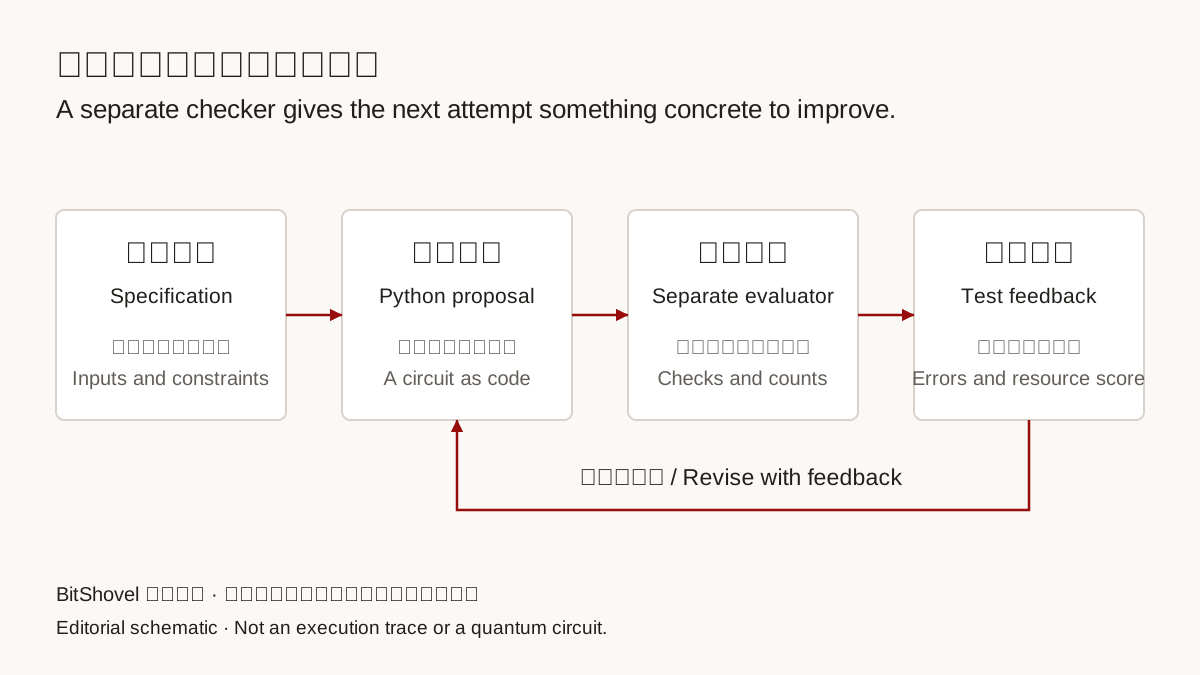
The model writes Python circuit proposals for an evaluator separate from the generator. The authors’ program checks task-specific inputs, outputs, workspace and phase, then counts resources; its feedback informs the next revision. Separate evaluation does not mean an independent research institution has replicated the work.
The often-cited 53 hours concerns the elliptic-curve exploration, not a common duration for all eight tasks. Researchers supplied the brief and occasionally prompted broader exploration. The meaningful mechanism is repeated external feedback on a candidate program; the model’s own assurance is not the acceptance test.
Sources and further reading
- Gu et al. · Original paper v1Preprint · October 15 UTC / 16 BeijingTask-specific distributions, resource measures and validation criteria, especially Extended Data Table 1 and supplementary methods.
- Anthropic · Quantum-circuit research explanationResearch-team explanation · Dated October 16Project context, the model’s role, the 53-hour example and human interventions.
- uncompute · Pinned code and resultsAuthors’ public repository · 64b5a13Inspectable task specifications, evaluators and resource counts; public code is not a BitShovel replication.
What tests, proofs and hardware runs establish
The eight tasks do not share a zero-error criterion. Some allow numerical error or a failure budget; others require exactness over the domain while still reporting finite tests. The divsteps Lean proof establishes a 590-step worst-case bound and branch-recovery conditions. The resource-saving circuit schedules 533 steps and charges rare longer paths to a failure budget. The documentation explicitly excludes a formal proof of the complete circuit or its resource count.
When reading AI-assisted research, identify the changed component, acceptance criterion, comparable baseline, proof boundary and any actual hardware measurement. Public tasks, code and proof entry points make further scrutiny possible; domain review and replication remain important. This connects to formalization more generally: checking a precisely defined object differs from proving an entire real-world process dependable.
- Continue: what formalization checks
- Check the research model and original access guidance
- Inspect the original tasks, evaluators and results
Sources and further reading
- Gu et al. · Original paper v1Preprint · October 15 UTC / 16 BeijingTask-specific distributions, resource measures and validation criteria, especially Extended Data Table 1 and supplementary methods.
- uncompute · Pinned code and resultsAuthors’ public repository · 64b5a13Inspectable task specifications, evaluators and resource counts; public code is not a BitShovel replication.
- Lean · Scope of the divsteps proofPinned revision · Mathematical obligationsA 590-step bound and branch recovery; the documentation excludes the complete circuit and resource count.
- Lean · DQI error bound and assumptionsPinned revision · A conditional proofError effects under distribution and failure-channel assumptions, not universal correctness of every implementation.