Applications · Government service
PlanAssist enters 15 English councils: AI first drafts in planning, and two numbers
On October 31 the official blog named it PlanAssist: DeepMind and the UK government put a Gemini-powered assistant into planning approval — validating application documents and drawings, checking heritage constraints and policy, drafting cited assessment reports, with officers keeping the final say. Barnet, Camden and Dorset piloted since June; official numbers put officer assessment time down up to 58%, and over 70% of report drafts approved by officers with no edits. It now enters a 12-month beta with 12 more councils joining in three cohorts (15 in total); whether it reaches all of England in 2027 depends on the tests. Read both numbers by their qualifiers: 58% is “up to”; 70%+ means “officers approved with no edits”, not “the reports were right”.
This account draws on the DeepMind blog “Speeding up planning decisions with AI” (October 31, 2026, Responsibility & Safety, by Owen Larter and David Thacker), the June 16, 2026 prototype announcement, the June 9, 2025 Extract announcement on the Google blog, and the MHCLG Digital blog (June 19, 2026). The 58%, 70%+, roughly-70%-workload, 8-to-4-weeks and 1.5-million-homes figures are all official claims; we ran nothing, did not use PlanAssist, and did not play the official demo video. The beta has just started: the 58% and 15-council figures come from the 3-council pilot, and the 2027 England-wide rollout is contingent on the beta. Official costs are not disclosed.
From Extract to PlanAssist: three steps in eighteen months
PlanAssist did not appear overnight. In June 2025 the government's AI incubator i.AI first built Extract: using Gemini (via Vertex AI) to turn old planning documents — blurry maps, handwritten notes — into structured data. The official comparison: converting one document manually takes up to 2 hours, Extract about 40 seconds; England sees roughly 350,000 planning applications a year; Extract trialed at 4 councils and, per the official account, reached every council in England in spring 2026.
The second step was the June 16, 2026 prototype announcement (unnamed at the time): Google DeepMind with the UK government, Google Cloud, Faculty, and the Barnet, Dorset and Camden councils. The assistant consolidates data onto one screen, flags relevant policies with citations, summarizes consultation feedback, and drafts first-draft reports with rationale and conditions; the stated goal is direct: halving decision times. The planner stays the final decision-maker, reviews every line, and the tool logs each step for an audit trail.
The third step was October 31: the name PlanAssist, the numbers, and the expansion. The 3 pilot councils (Barnet, Camden, Dorset) have run since June; next comes a 12-month beta adding 12 councils in three cohorts (15 total); whether it reaches all of England in 2027 is contingent on the beta. The same blog gives the numbers: officer time assessing householder applications down up to 58%, over 70% of report drafts approved by officers with no edits; routine householder applications are up to 70% of officers' workloads.
Sources and further reading
- DeepMind: Speeding up planning decisions with AI (PlanAssist)Official blog · October 31, 2026 · read in full November 3, 2026The original source for the PlanAssist name and the beta plan: built with Gemini; developed with the UK government, Google Cloud and Faculty; validates application documents and architectural drawings, checks heritage constraints (the blog's example is tree preservation orders), local and national policy, and prior objections; drafts fully cited assessment reports for officer review; officers keep the final say on every application. Numbers: officer time on householder assessments down up to 58%; over 70% of generated reports approved with no edits; routine householder applications are up to 70% of officers' workloads. Pilots in Barnet, Camden and Dorset since June; a 12-month beta adds 12 councils in three cohorts (15 total); any 2027 England-wide rollout is subject to successful testing; the UK targets 1.5 million new homes by 2029. By Owen Larter and David Thacker, Responsibility & Safety. The embedded official demo video could not be played here.
- DeepMind: Unlocking UK house-building with AI-accelerated planningOfficial blog (prototype announcement) · June 16, 2026 · read November 3, 2026The prototype announcement (unnamed at the time): Google DeepMind with the UK government, Google Cloud, Faculty, and Barnet/Dorset/Camden; the assistant consolidates data onto one screen, flags relevant policies with citations, summarizes consultation feedback (objections and precedents), and drafts first-draft reports with rationale and conditions; the planner stays the final decision-maker, reviews every line, and the tool logs each step for an audit trail; the stated goal is halving decision times; householder applications are nearly 70% of applications each year; national rollout planned from 2027; Extract had been trialed across 20+ local planning authorities and saves the average council about 255 hours a year; quote from Naisha Polaine of Barnet Council.
- Google blog: UK government harnesses Gemini… (Extract)Official blog · June 9, 2025 · read November 3, 2026The earlier timeline segment: the government's AI incubator i.AI built Extract and chose Gemini (via Vertex AI); it converts old planning documents — blurry maps, handwritten notes — into structured data; manual conversion of one document takes up to 2 hours, Extract about 40 seconds; first trialed at 4 councils (Hillingdon, Westminster City, Nuneaton and Bedworth, Exeter City), with the official account saying it reached every council in England in spring 2026; England sees roughly 350,000 planning applications a year.
What PlanAssist reviews
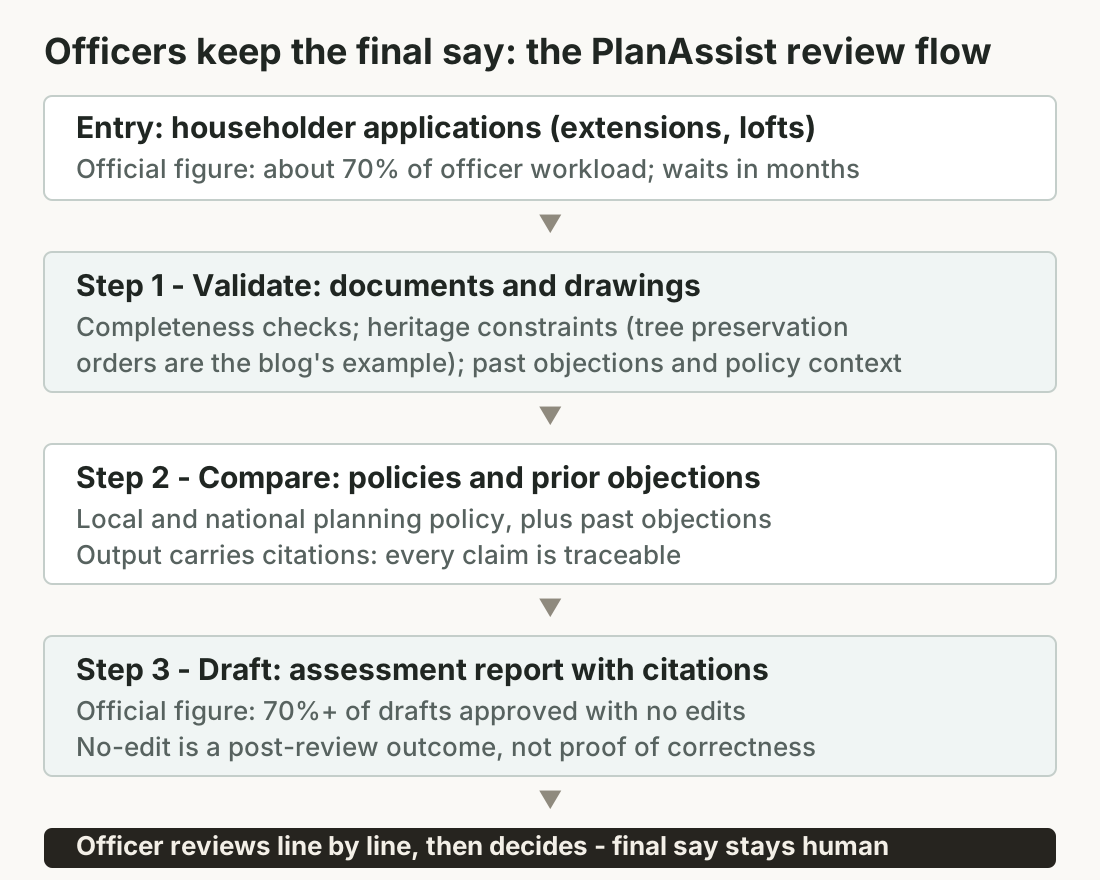
PlanAssist works on householder applications — extensions, loft conversions, that tier of routine work, officially about 70% of officers' workloads. The work has three stages: validate first, checking application documents and architectural drawings; then compare, checking heritage constraints (the official blog's example is tree preservation orders), local and national policy, and prior objections; then draft, producing a first-draft assessment report with full citations for planning officers to review. The official blog's phrasing: it “speeds up routine checks while ensuring planning officers retain the final say on every application”.
Citations are the core of the design. The report is not a conclusion but a checkable draft: every claim carries its source, and officers trace it — the local policy text, the heritage constraint, the past objection. The June prototype announcement is more specific: officers review line by line, and the tool logs each step for an audit trail; MHCLG adds that experts including the Planning Inspectorate advise on handling policy and precedent data accurately. MHCLG also records a pilot officer's observation: the tool is “a job satisfaction tool as much as an efficiency one” — freeing officers from routine checks for the parts that need human judgment.
Sources and further reading
- DeepMind: Speeding up planning decisions with AI (PlanAssist)Official blog · October 31, 2026 · read in full November 3, 2026The original source for the PlanAssist name and the beta plan: built with Gemini; developed with the UK government, Google Cloud and Faculty; validates application documents and architectural drawings, checks heritage constraints (the blog's example is tree preservation orders), local and national policy, and prior objections; drafts fully cited assessment reports for officer review; officers keep the final say on every application. Numbers: officer time on householder assessments down up to 58%; over 70% of generated reports approved with no edits; routine householder applications are up to 70% of officers' workloads. Pilots in Barnet, Camden and Dorset since June; a 12-month beta adds 12 councils in three cohorts (15 total); any 2027 England-wide rollout is subject to successful testing; the UK targets 1.5 million new homes by 2029. By Owen Larter and David Thacker, Responsibility & Safety. The embedded official demo video could not be played here.
- MHCLG Digital: Using AI to support planning decisionsGovernment blog · June 19, 2026 · read November 3, 2026The government-side account: the tool was called an “AI-Augmented Planning Decisions tool”; the target was cutting processing from 8 weeks to 4; alpha testing began in May with a rollout decision originally due at the end of summer and possible wider rollout in 2027; 3 pilot LPAs (Dorset/Camden/Barnet) with 9 more councils possibly joining a 12-month test; an RIBA survey: 80% of practices faced delays and over 10% abandoned projects as a result; quotes from Cllr Ross Houston (Barnet) and RIBA President Chris Williamson; planners testing it called it “a job satisfaction tool as much as an efficiency one”; the officer remains the key decision maker; the tool must comply fully with legal and human-rights obligations; experts including the Planning Inspectorate advise on accurate handling of policy and precedent data.
Two numbers, two readings
First number: 58%. The official sentence is officer time down “up to” 58% — the qualifier sits in front of the number; it is the official claim from the 3-council pilot, and it measures the time officers spend assessing householder applications, not decision time. Decision time is a different measure: MHCLG wrote in June of “8 weeks to 4 weeks” — a government target, not a measured result. The two must not be mixed: saving 58% of officer time is not the same as halving residents' waits — queues, appeals and complex cases still set the wait.
The second number is subtler: 70%+ of reports “approved with no edits”. It measures how often officers pass a draft without changing it — a post-review measure. An honest reading has two sides: the official narrative — a fully cited draft makes the officer's check faster; and the equally honest other side — no-edit approval does not mean the report was right; it says the officer changed nothing after review, not that anyone independently verified each citation's text and source; whether review depth holds as officer workload compresses is exactly what the beta has to answer.
This is the same discipline as this morning's census piece: the qualifiers in front of numbers are the methodology — “up to 58%”, “no-edit after officer review 70%+”, “8-to-4 weeks is a target”. We reproduced none of the figures; the 3-council pilot is a small sample, and the 15-council beta is the first at-scale test of both numbers; costs are undisclosed — whether DeepMind charges councils, and who pays for Gemini inference, has no first-party material.
Sources and further reading
- DeepMind: Speeding up planning decisions with AI (PlanAssist)Official blog · October 31, 2026 · read in full November 3, 2026The original source for the PlanAssist name and the beta plan: built with Gemini; developed with the UK government, Google Cloud and Faculty; validates application documents and architectural drawings, checks heritage constraints (the blog's example is tree preservation orders), local and national policy, and prior objections; drafts fully cited assessment reports for officer review; officers keep the final say on every application. Numbers: officer time on householder assessments down up to 58%; over 70% of generated reports approved with no edits; routine householder applications are up to 70% of officers' workloads. Pilots in Barnet, Camden and Dorset since June; a 12-month beta adds 12 councils in three cohorts (15 total); any 2027 England-wide rollout is subject to successful testing; the UK targets 1.5 million new homes by 2029. By Owen Larter and David Thacker, Responsibility & Safety. The embedded official demo video could not be played here.
- MHCLG Digital: Using AI to support planning decisionsGovernment blog · June 19, 2026 · read November 3, 2026The government-side account: the tool was called an “AI-Augmented Planning Decisions tool”; the target was cutting processing from 8 weeks to 4; alpha testing began in May with a rollout decision originally due at the end of summer and possible wider rollout in 2027; 3 pilot LPAs (Dorset/Camden/Barnet) with 9 more councils possibly joining a 12-month test; an RIBA survey: 80% of practices faced delays and over 10% abandoned projects as a result; quotes from Cllr Ross Houston (Barnet) and RIBA President Chris Williamson; planners testing it called it “a job satisfaction tool as much as an efficiency one”; the officer remains the key decision maker; the tool must comply fully with legal and human-rights obligations; experts including the Planning Inspectorate advise on accurate handling of policy and precedent data.
A 12-month beta: what to watch
The beta's shape: 12 months, 12 new councils in three cohorts, 15 total; the official text makes the 2027 England-wide rollout “subject to successful testing”, and every assessment is still reviewed and approved by a qualified planning officer. This is not a fully open service — it sits at the stage between pilot and national rollout where the data matters most: both 58% and 70%+ come from a 3-council pilot, and the 15-council numbers are the first at-scale test.
What to watch: one, whether the numbers hold at 15-council scale; two, how officers handle citation checks — the other side of the no-edit rate is whether officers genuinely review line by line, and review depth in the beta is what gives these numbers their quality; three, the resident experience — the June target was 8 weeks to 4, and whether waits actually shrink needs measured results; four, costs and liability — whether DeepMind charges, and who is liable for errors, are both undisclosed.
How it connects to existing pieces: Anima put three AI colleagues into a clinic (calls and paperwork), and Retell runs 100 million calls a month — they and PlanAssist are the same pattern at different stages: capability (Gemini or the GPT family) enters institutional routine work through a company's integration, produces checkable first drafts, and people keep the final say. All three report official or company figures the site has not reproduced; the difference is stage: Retell and Anima run in production, while PlanAssist sits between pilot and beta — which is why this piece reads the numbers closely, treating it as an early-integration sample, not a validated service outcome.
Sources and further reading
- DeepMind: Speeding up planning decisions with AI (PlanAssist)Official blog · October 31, 2026 · read in full November 3, 2026The original source for the PlanAssist name and the beta plan: built with Gemini; developed with the UK government, Google Cloud and Faculty; validates application documents and architectural drawings, checks heritage constraints (the blog's example is tree preservation orders), local and national policy, and prior objections; drafts fully cited assessment reports for officer review; officers keep the final say on every application. Numbers: officer time on householder assessments down up to 58%; over 70% of generated reports approved with no edits; routine householder applications are up to 70% of officers' workloads. Pilots in Barnet, Camden and Dorset since June; a 12-month beta adds 12 councils in three cohorts (15 total); any 2027 England-wide rollout is subject to successful testing; the UK targets 1.5 million new homes by 2029. By Owen Larter and David Thacker, Responsibility & Safety. The embedded official demo video could not be played here.
- DeepMind: Unlocking UK house-building with AI-accelerated planningOfficial blog (prototype announcement) · June 16, 2026 · read November 3, 2026The prototype announcement (unnamed at the time): Google DeepMind with the UK government, Google Cloud, Faculty, and Barnet/Dorset/Camden; the assistant consolidates data onto one screen, flags relevant policies with citations, summarizes consultation feedback (objections and precedents), and drafts first-draft reports with rationale and conditions; the planner stays the final decision-maker, reviews every line, and the tool logs each step for an audit trail; the stated goal is halving decision times; householder applications are nearly 70% of applications each year; national rollout planned from 2027; Extract had been trialed across 20+ local planning authorities and saves the average council about 255 hours a year; quote from Naisha Polaine of Barnet Council.
- MHCLG Digital: Using AI to support planning decisionsGovernment blog · June 19, 2026 · read November 3, 2026The government-side account: the tool was called an “AI-Augmented Planning Decisions tool”; the target was cutting processing from 8 weeks to 4; alpha testing began in May with a rollout decision originally due at the end of summer and possible wider rollout in 2027; 3 pilot LPAs (Dorset/Camden/Barnet) with 9 more councils possibly joining a 12-month test; an RIBA survey: 80% of practices faced delays and over 10% abandoned projects as a result; quotes from Cllr Ross Houston (Barnet) and RIBA President Chris Williamson; planners testing it called it “a job satisfaction tool as much as an efficiency one”; the officer remains the key decision maker; the tool must comply fully with legal and human-rights obligations; experts including the Planning Inspectorate advise on accurate handling of policy and precedent data.