Existing footage · Find a moment and continue the edit
How do you find the moment worth cutting from all that footage?
Jockey answers video questions with clips and timestamps, then lets a person trim, reorder and export. Its official 4.4-second bottle example shows how finding footage can lead to an editable cut.
Jockey announced general availability on October 15. This reading examines official illustrations, interfaces and current conditions, retaining the illustrative labels. BitShovel did not connect an account, upload footage or generate a reel.
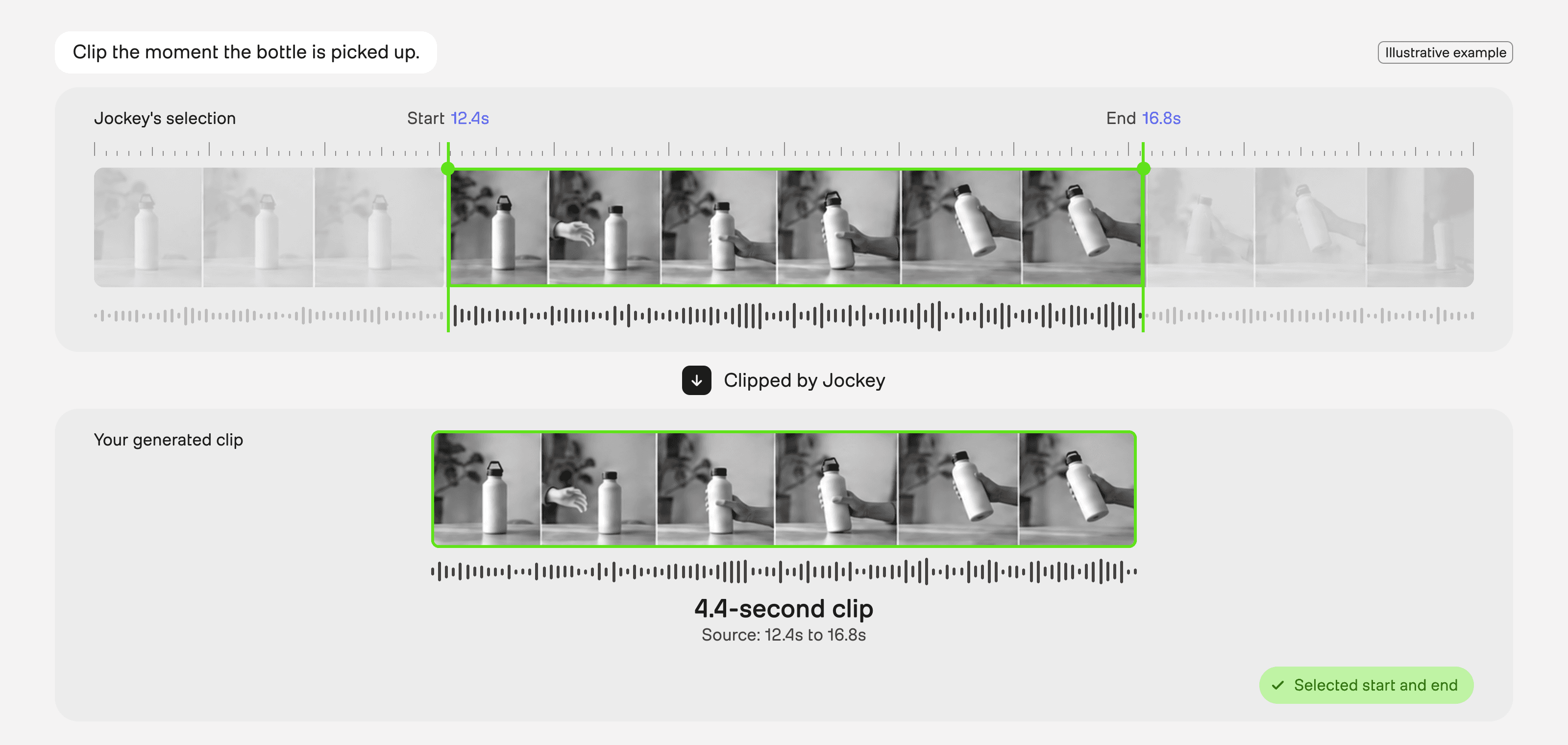
How does a bottle pickup become a 4.4-second clip?
The official illustration asks for the moment a bottle is picked up. A source range of 12.4–16.8 seconds becomes a 4.4-second clip. It makes the expected output concrete: a video assistant needs to return a source-backed segment with boundaries that a person can inspect and use.
The end of an interview sentence or the pause before an action can affect its meaning. The October 15 update emphasizes preserving sub-second boundaries. A person still needs to review whether the selected range retains the context they want; this diagram does not establish that every selection is appropriate.
Sources and further reading
- TwelveLabs · Jockey GA and seven updatesOfficial announcement · October 15, 2026Original illustrations, sub-second boundaries, timeline trimming and ordering, MP4 and shareable results. The illustrations are not independent tests.
A useful result leads back to the original footage
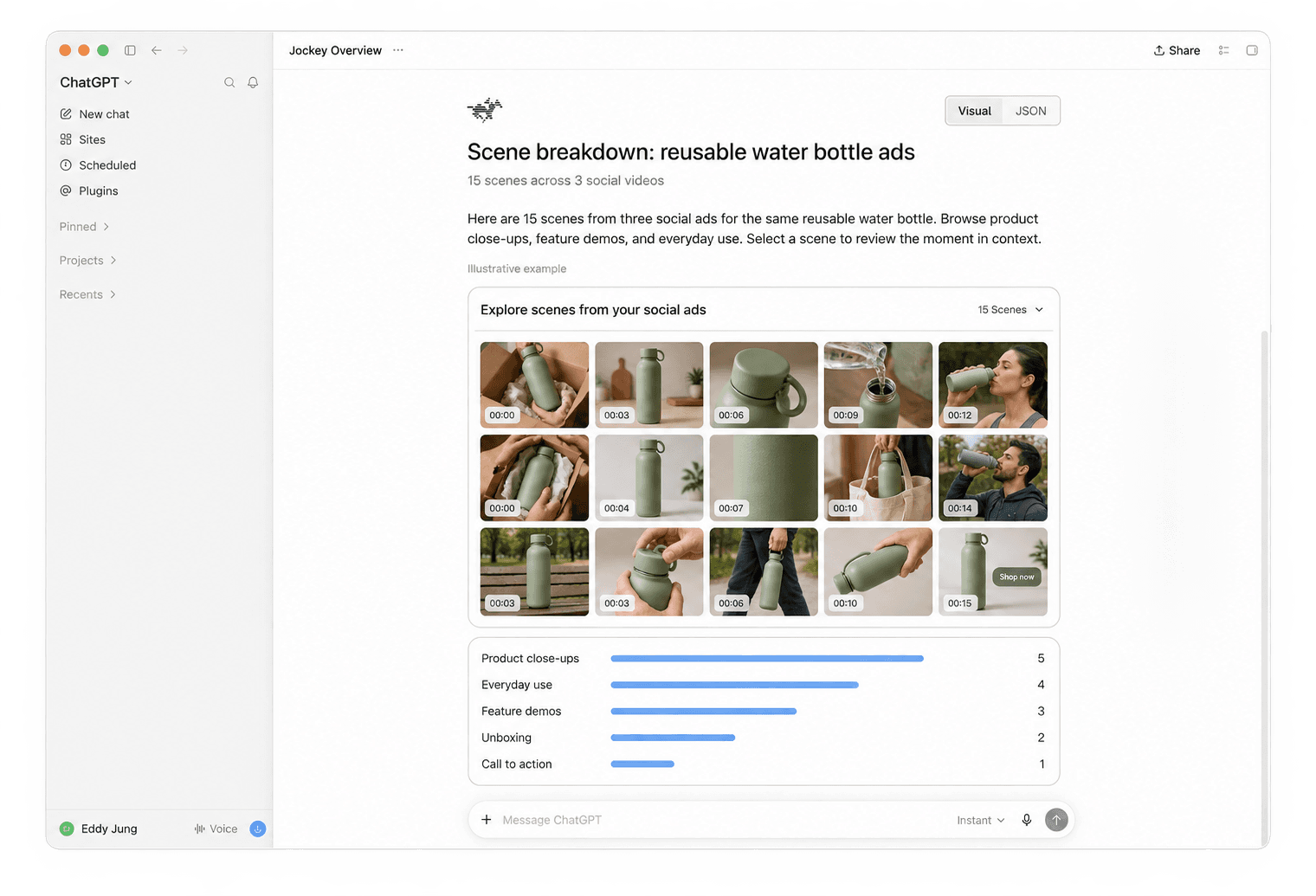
Another official view illustrates 15 scenes from three bottle ads, with thumbnails and timestamps for close-ups, unboxing, pouring and everyday use. It suggests a way to organize footage: ask where an action appears, then return to those moments instead of relying on an overall summary.
TwelveLabs describes Marengo as finding relevant visual, audio and text information, Pegasus as helping interpret events, and Jockey as bringing these capabilities into library-wide conversation. An interview, product demo or trip can start with a remembered detail. Returning to its source gives the person a way to judge the answer.
Sources and further reading
- TwelveLabs · Jockey GA and seven updatesOfficial announcement · October 15, 2026Original illustrations, sub-second boundaries, timeline trimming and ordering, MP4 and shareable results. The illustrations are not independent tests.
- Jockey · Library and editing entryOfficial product page · checked October 16Semantic retrieval, source inspection and assembly as product functions, without an inferred success rate.
- TwelveLabs · Importing footage and following referencesOfficial connection guide · September 29, 2026Accounts, MCP connection, upload links, processing and timestamped results. Conversational imports have their own route, distinct from raw API requirements.
Let AI assemble a first cut that a person can continue
Retrieval finds candidates, boundaries define ranges, and sequencing connects them. Jockey’s timeline lets a person trim, reorder and preview an assembled reel before exporting an MP4. Analysis can also be saved as a shareable Jockey artifact whose cited moments can be reopened.
This continues the Manus video-editor question of how work proceeds after a first version. Existing footage adds an earlier step: deciding what to keep from longer sources. Jockey starts from those moments; the Manus case shows chat and manual editing within one project. They are references for human handoff, without implying a shared model or pipeline.
Sources and further reading
- TwelveLabs · Jockey GA and seven updatesOfficial announcement · October 15, 2026Original illustrations, sub-second boundaries, timeline trimming and ordering, MP4 and shareable results. The illustrations are not independent tests.
- Jockey · Library and editing entryOfficial product page · checked October 16Semantic retrieval, source inspection and assembly as product functions, without an inferred success rate.
Start with a small source and check the account limits
This workflow needs a TwelveLabs account and a supported ChatGPT or Claude connection. Device and Google Drive files enter the library through an upload link; conversational imports can also accept YouTube or direct video links. Queries follow encoding and indexing. The footage enters a cloud library: confirm permission to upload and share it, then check the service’s storage and sharing rules.
The monthly plans checked October 16 list Free at $0 with 3GB of cumulative storage, Plus at $29 with 50GB, and Pro at $99 with 200GB. Responses and other operations have a monthly Workload allowance. Storage is not a fresh allocation each month, and free does not mean unlimited processing. New users enter the new billing from October 15; existing Free, Developer and Jockey subscribers have different migration dates.
An editorial starting point is a short video you know and are entitled to upload. Ask a verifiable question about a person, action or quotation, then inspect its timestamp, context and boundaries before assembling a reel. BitShovel reviewed public material without importing footage, creating a shareable artifact or auditioning a finished video.
- Read the footage-import guide
- Check current plans and allowances
- Existing account: check the migration rules
Sources and further reading
- TwelveLabs · Importing footage and following referencesOfficial connection guide · September 29, 2026Accounts, MCP connection, upload links, processing and timestamped results. Conversational imports have their own route, distinct from raw API requirements.
- TwelveLabs · Current plans and allowancesOfficial pricing · checked October 16Monthly prices, cumulative asset storage and monthly Workload; free access is not unlimited footage or responses.
- TwelveLabs · Billing migration for existing accountsOfficial migration documentation · checked October 16New users enter the new billing from October 15; existing Free, Developer and Jockey subscribers move on different schedules.