Models and evaluation
Gemini 4 Neon ships: a mid-tier 61 past Carbon, with cached input at −95%
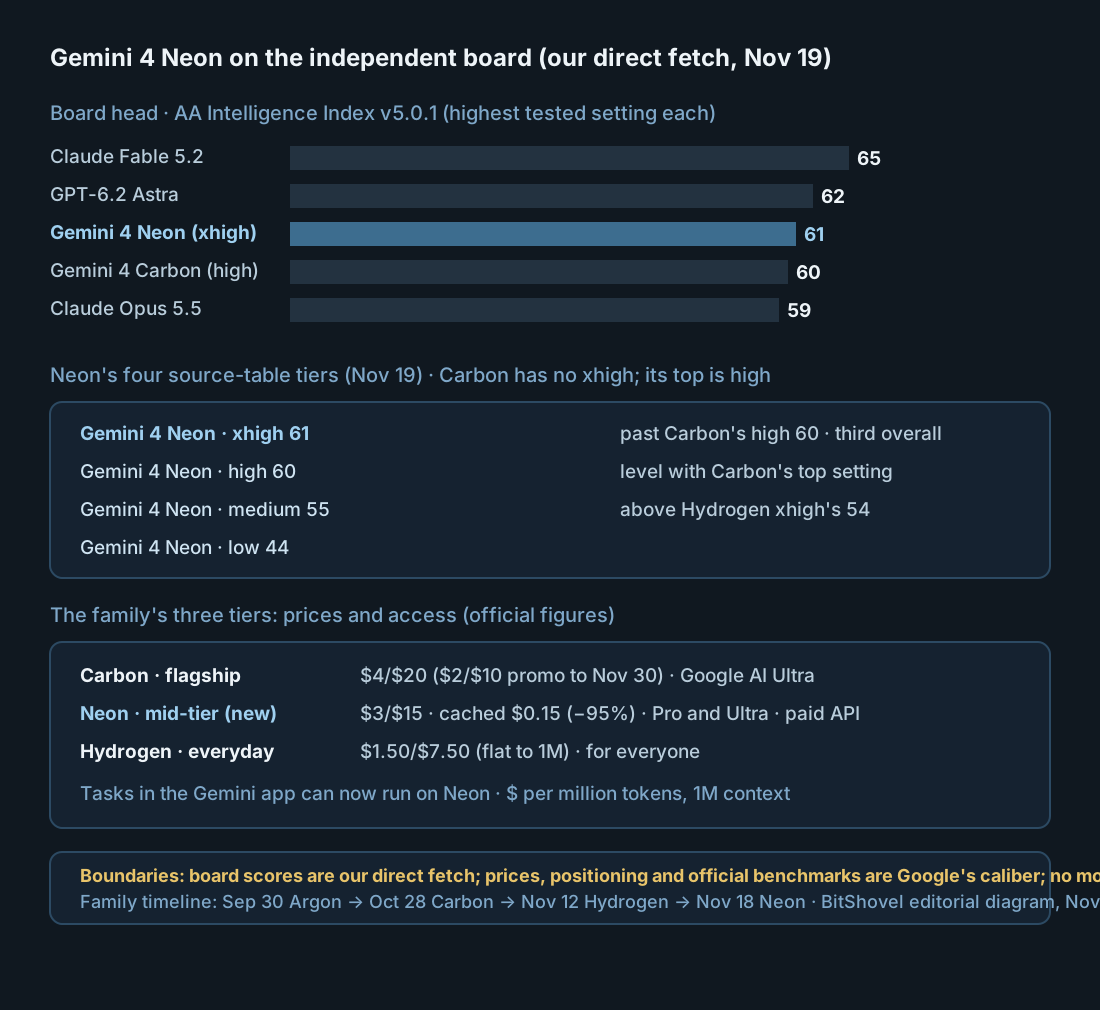
Google shipped Gemini 4 Neon on November 18 — the family's third new tier in 21 days, officially positioned as "frontier-level intelligence with fast end-to-end task completion across complex software engineering, knowledge work, and science workflows", sitting between Carbon (the hardest long-horizon projects) and Hydrogen (fast everyday execution). The independent coordinates (this site's direct AA full-board fetch on November 19, v5.0.1 unchanged): the source table adds four Neon rows — xhigh 61 / high 60 / medium 55 / low 44; under this board's highest-tested-setting rule, 61 ranks third — behind GPT-6.2 Astra's 62, ahead of Carbon's 60, matching the official "#3 overall at xhigh 61" claim. The board head now holds five contenders inside six integer points: Fable 5.2 65, Astra 62, Neon 61, Carbon 60, Opus 5.5 59. The structural note worth keeping: Carbon's thinking ladder stops at high (no xhigh), so the mid-tier's top setting outscores the family flagship's top setting — the second such inversion in this family after Hydrogen (54) passed Argon (50); and Google's own comparison table marks Neon's losses — Terminal-Bench 4.1 at 65.2 against Opus 5.5's 65.8, FrontierCode 2.0 at 46.2 against 47.3, Chartography at 73.5 against Sol's 75.1. Price is the mid-tier's reason to exist: $3 input / $15 output / $0.15 cached input per million tokens (a 95% discount, less than half Astra's $0.40 cached rate) — officially 32% lower cost per task than Carbon at high, on the Pareto frontier of the Vals and Agent Arena indexes (50–80% below top frontier models per task), and still 36%+ cheaper than competitors' top settings at xhigh. Safety, quoted as vendor caliber: Carbon-level protections against severe misuse and prompt injection at far lower refusal cost — 1.98% refusals on Terminal-Bench 4.0 and 0% on Terminal-Bench-Science; 0.0% cheating, 2.45% shortcuts (the family's lowest), 99.2% pass on the agent-honesty evaluation, 0.09% misaligned-action rate; 0.0% attack success on Gray Swan's indirect-prompt-injection benchmark at xhigh with real-time safeguards. Access: paid API tier (AI Studio / Android Studio), the Gemini app and Antigravity for Pro/Ultra subscribers, business via API or the model dropdown; Tasks inside the Gemini app can now run on Neon — joining this site's ongoing Tasks tracking line; and "Neon for cyber" reaches trusted defenders via the Fairwind Program in the coming days. This site ran no model and reproduced no benchmark; all official efficiency and safety figures are vendor caliber (the methodology page and model card were not read); the independent board score is recorded separately and does not substitute for them.
This account rests on two sources: Google DeepMind's official announcement "Introducing Gemini 4 Neon" (page dated November 18, read in full by this site on November 19, with the attached official benchmark table and family comparison chart checked alongside), and this site's direct full-board fetch of the Artificial Analysis intelligence board in the early hours of November 19 (both the server-rendered rows and the page's embedded metadata checked). All official benchmark, efficiency and safety figures are vendor caliber; the board scores are this site's direct readings — the two calibers are kept apart and do not substitute for each other; this site ran no model and reproduced no benchmark.
A third tier in 21 days: Neon fills the family's middle band
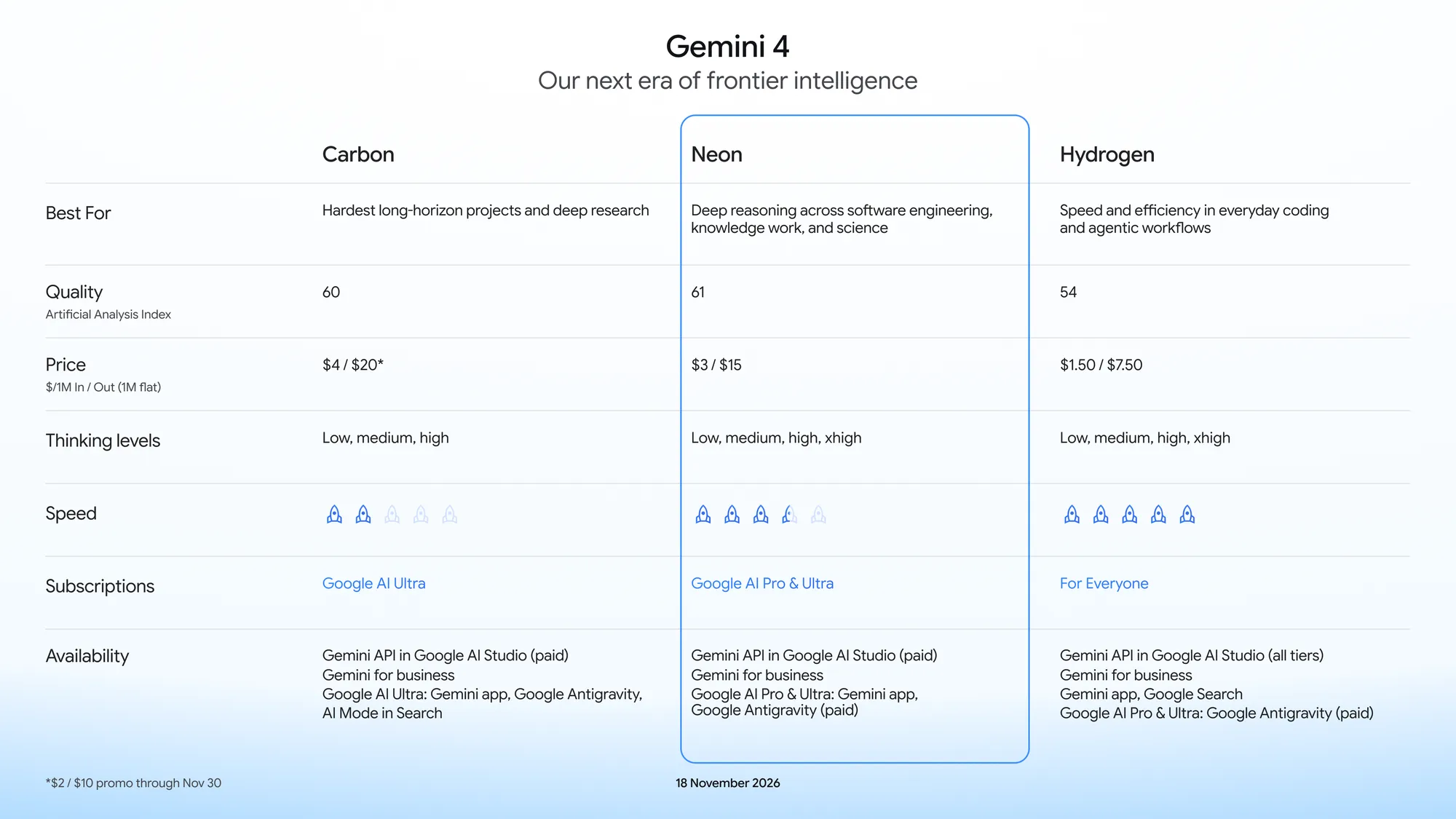
On November 18, Google DeepMind shipped Gemini 4 Neon, officially positioned in one line as "bringing frontier-level intelligence with fast end-to-end task completion across complex software engineering, knowledge work, and science workflows". Placed on this site's recorded family timeline, it is the family's third new tier in 21 days: Argon on September 30, Carbon on October 28, Hydrogen on November 12, Neon on November 18. The official family chart writes the division of labor in three rows — Carbon takes the hardest long-horizon projects and deep research, Hydrogen takes speed and efficiency in everyday coding and agentic workflows, and Neon's cell reads "deep reasoning across software engineering, knowledge work, and science": it is not another flagship but the tier that puts frontier scores inside high-frequency complex work.
The configuration follows the family's two established axes. Thinking levels: like Hydrogen, Neon ships four (low / medium / high / xhigh) — the flagship Carbon has only three, with no xhigh; context is 1M tokens. Pricing sits in the announcement: $3 input, $15 output, and $0.15 cached input per million tokens — the cached rate is 5% of list (a 95% discount), and against GPT-6.2 Astra's $0.40 cached rate this mid-tier prices the agent arithmetic of "the more repeated prefixes, the cheaper" one notch lower. Access runs four ways: the paid API tier (AI Studio and Android Studio); the Gemini app's model dropdown for Pro and Ultra subscribers; Google Antigravity (Pro/Ultra); and Gemini for business via the API or the model dropdown. Hydrogen's "for everyone" does not spill over to Neon — the Gemini app's free tier stays at Hydrogen's row of the family chart. One line ties straight to daily use: Tasks inside the Gemini app can now run on Neon for multistep jobs.
The announcement also gives Neon an engineering role: inside Antigravity it can act as "a fast, high-judgment Orchestrator directing parallel Hydrogen subagents" — cutting redundant file reads, sharing progress as it works, and compacting context reliably in long sessions. That extends the Orchestrator shipped with Hydrogen (which switched between Carbon and Hydrogen): the dispatch seat once held by the flagship-plus-everyday pair can now be taken by the mid-tier itself. The announcement is signed by Koray Kavukcuoglu; the official benchmark table, family chart and methodology page travel with the text, and the model card is linked separately (not read by this site).
Sources and further reading
- Google's official announcement: Introducing Gemini 4 NeonOfficial release · page dated November 18, 2026 · read in full by this site on November 19Read in full. Checked the key contents: positioned for "frontier-level intelligence with fast end-to-end task completion across complex software engineering, knowledge work, and science workflows"; AA Intelligence Index 61 at xhigh, #3 overall ("just behind larger, slower models"); #1 on the AA Coding Agent Index (58.6); #2 on the Vals Index (70.9%) on the Pareto frontier, #1 on both the Legal Research Bench and Tax Agent Bench; Agent Arena Index debut at #2 (1336 across 4,200+ real sessions), #2 steerability; Surge AI #1 on most of finance, accounting, spreadsheet modeling and complex constraint following; Chartography 73.5%; Agents' Last Exam v1.1 75.8%; Zapier AutomationBench #1 (56.3%); Vending-Bench 2 #1 ($16,843); Terminal-Bench Science 70.5%, RiemannBench 84.0%, HLE-Diamond 71.3%. Pricing: $3 / $0.15 cached (95% discount) / $15 per million tokens, 1M context. Access: Gemini API paid tier (AI Studio, Android Studio), Antigravity (Pro/Ultra), AI Studio (Pro/Ultra), Gemini for business (API and model dropdown), the Gemini app (Pro/Ultra dropdown); the Fairwind cyber edition in the coming days. Official efficiency caliber (vendor-assessed): 32% lower cost per task than Carbon at high; Pareto frontier on Vals and Agent Arena at 50–80% below top frontier models per task; xhigh still 36%+ cheaper than competitors' highest settings. Coding: Terminal-Bench 4.1 65.2%, FrontierCode 2.0 46.2% (high), SWE-sweep 12.8% on the mini-SWE harness against 39.0% inside Antigravity (the harness gap is given side by side in official text); can act as an Orchestrator directing parallel Hydrogen subagents in Antigravity, cutting redundant file reads, sharing progress and compacting context reliably. Cyber (Neon for cyber): AutoBaxBench hard tier 76% SOTA (ahead of Carbon across easy/medium/hard); WebExploitBench v1.2 51.26% SOTA at about half the cost of competing large models; SEC-bench Pro 90.5% SOTA at roughly half the cost per challenge; ExploitGym at frontier level with half the tokens of Carbon; CWE-bench v2 70.7% (+3.4% over Carbon). Safety: Carbon-level protections against severe misuse and prompt injection; refusals of just 1.98% on Terminal-Bench 4.0 and 0% on Terminal-Bench-Science; chain-of-thought and action misalignment monitor alert rates below Carbon's baselines; 0.0% cheating on Terminal-Bench 4.0 and 2.45% shortcuts on the coding cheating evaluation (the family's lowest); 0.09% misaligned-action rate; 99.2% pass on the agent honesty evaluation; under-service down 43–56% and overreach down 15–35% versus Carbon across effort levels; 0.0% attack success on Gray Swan's IPI benchmark at xhigh with real-time safeguards (previously reached only by other Gemini models). Tasks in the Gemini app can now run on Neon. The model card is linked from the post (not read by this site).
Independent coordinates: 61 in third, five contenders inside six integer points
This site's direct full-board fetch of the Artificial Analysis intelligence board in the early hours of November 19 (the methodology page's v5.0.1 label unchanged, so rounds stay comparable): the source table adds four Gemini 4 Neon rows — xhigh 61.40 displaying as 61, high 59.62 as 60, medium 54.86 as 55, low 44.08 as 44; the embedded metadata reads releaseDate 2026-11-18, not deprecated, a reasoning model, 1,000,000-token context. The visible main table renders one row per model with the top effort inline — Neon reads "Gemini 4 Neon Xhigh 61", sorted after GPT-6.2 Astra (Max 62) and before Carbon (High 60). The official claim of "#3 overall at xhigh 61, just behind larger, slower models" matches the direct read; the #1 spot on the AA Coding Agent Index (58.6) travels with it.
Under this board's highest-tested-setting-per-model rule, Neon joins at 61 in third, and the catalogued row count moves 37→38. The board head now holds five contenders: Fable 5.2's 65, Astra's 62, Neon's 61, Carbon's 60 and Opus 5.5's 59 — five models from four organizations inside six integer points, and the order where Carbon's "first at 60" stood two weeks ago has been rewritten three times since, by Fable 5.2 (65), GPT-6.2 Astra (62) and now Neon (61). One structural detail deserves its own line: Carbon's thinking ladder stops at high, so its 60 is its ceiling; Neon's high tier also reads 60, level with the flagship's best, while its xhigh 61 passes it. This is the family's second inversion of "the lower tier passing the tier above" — Hydrogen's xhigh 54 already stood above Argon's high 50 at launch.
The official cost caliber is quoted as given and flagged vendor-assessed throughout: at high, "a high AA score with 32% lower cost per task than Carbon"; on the Pareto frontier of both the Vals and Agent Arena indexes at high, roughly 50–80% below top frontier models per task; and at xhigh still 36%+ cheaper than competitors' highest settings. The way to hold these beside the independent 61 is the same as every round: neither caliber substitutes for the other — the board says which row the model sits in, and the vendor's cost ledger says what a seat in that row costs.
Sources and further reading
- The Artificial Analysis intelligence board (this site's direct full fetch)Independent evaluation · direct fetch by this site on November 19, 2026Direct fetch and checked. The source table adds four Gemini 4 Neon rows: Xhigh 61 (61.40) / High 60 (59.62) / Medium 55 (54.86) / Low 44 (44.08); the embedded metadata reads releaseDate 2026-11-18, deprecated: false, isReasoning: true, a 1,000,000-token context window, creator Google. The visible main table renders one row per model with the effort inline — Neon shows "Gemini 4 Neon Xhigh 61", sorted after GPT-6.2 Astra (Max 62) and before Carbon (High 60). All other 36 catalogued rows keep their highest-tested scores and settings (Fable 5.2 leads at max 65); the retired rows (GPT-6 Astra, GPT-6.1 Sol, Qwen3.8 Max 0902, Gemini 3.8 Flash) remain absent; uncatalogued rows (Inkling 2 Small 31, Agnes 2.5 Pro Theta 24, DeepSeek V4 Pro 0813 23, Nanbeige4.3-33B 20, the K2 Horizon family, JoyAI-VL-Preview 28 and others) stay outside as usual; the Grok 4.7 row displays Xhigh 35 (consistent with the November 16 note, value unchanged).
- Google's official announcement: Introducing Gemini 4 NeonOfficial release · page dated November 18, 2026 · read in full by this site on November 19Read in full. Checked the key contents: positioned for "frontier-level intelligence with fast end-to-end task completion across complex software engineering, knowledge work, and science workflows"; AA Intelligence Index 61 at xhigh, #3 overall ("just behind larger, slower models"); #1 on the AA Coding Agent Index (58.6); #2 on the Vals Index (70.9%) on the Pareto frontier, #1 on both the Legal Research Bench and Tax Agent Bench; Agent Arena Index debut at #2 (1336 across 4,200+ real sessions), #2 steerability; Surge AI #1 on most of finance, accounting, spreadsheet modeling and complex constraint following; Chartography 73.5%; Agents' Last Exam v1.1 75.8%; Zapier AutomationBench #1 (56.3%); Vending-Bench 2 #1 ($16,843); Terminal-Bench Science 70.5%, RiemannBench 84.0%, HLE-Diamond 71.3%. Pricing: $3 / $0.15 cached (95% discount) / $15 per million tokens, 1M context. Access: Gemini API paid tier (AI Studio, Android Studio), Antigravity (Pro/Ultra), AI Studio (Pro/Ultra), Gemini for business (API and model dropdown), the Gemini app (Pro/Ultra dropdown); the Fairwind cyber edition in the coming days. Official efficiency caliber (vendor-assessed): 32% lower cost per task than Carbon at high; Pareto frontier on Vals and Agent Arena at 50–80% below top frontier models per task; xhigh still 36%+ cheaper than competitors' highest settings. Coding: Terminal-Bench 4.1 65.2%, FrontierCode 2.0 46.2% (high), SWE-sweep 12.8% on the mini-SWE harness against 39.0% inside Antigravity (the harness gap is given side by side in official text); can act as an Orchestrator directing parallel Hydrogen subagents in Antigravity, cutting redundant file reads, sharing progress and compacting context reliably. Cyber (Neon for cyber): AutoBaxBench hard tier 76% SOTA (ahead of Carbon across easy/medium/hard); WebExploitBench v1.2 51.26% SOTA at about half the cost of competing large models; SEC-bench Pro 90.5% SOTA at roughly half the cost per challenge; ExploitGym at frontier level with half the tokens of Carbon; CWE-bench v2 70.7% (+3.4% over Carbon). Safety: Carbon-level protections against severe misuse and prompt injection; refusals of just 1.98% on Terminal-Bench 4.0 and 0% on Terminal-Bench-Science; chain-of-thought and action misalignment monitor alert rates below Carbon's baselines; 0.0% cheating on Terminal-Bench 4.0 and 2.45% shortcuts on the coding cheating evaluation (the family's lowest); 0.09% misaligned-action rate; 99.2% pass on the agent honesty evaluation; under-service down 43–56% and overreach down 15–35% versus Carbon across effort levels; 0.0% attack success on Gray Swan's IPI benchmark at xhigh with real-time safeguards (previously reached only by other Gemini models). Tasks in the Gemini app can now run on Neon. The model card is linked from the post (not read by this site).
The official table's wins and losses: three grey marks and one harness gap
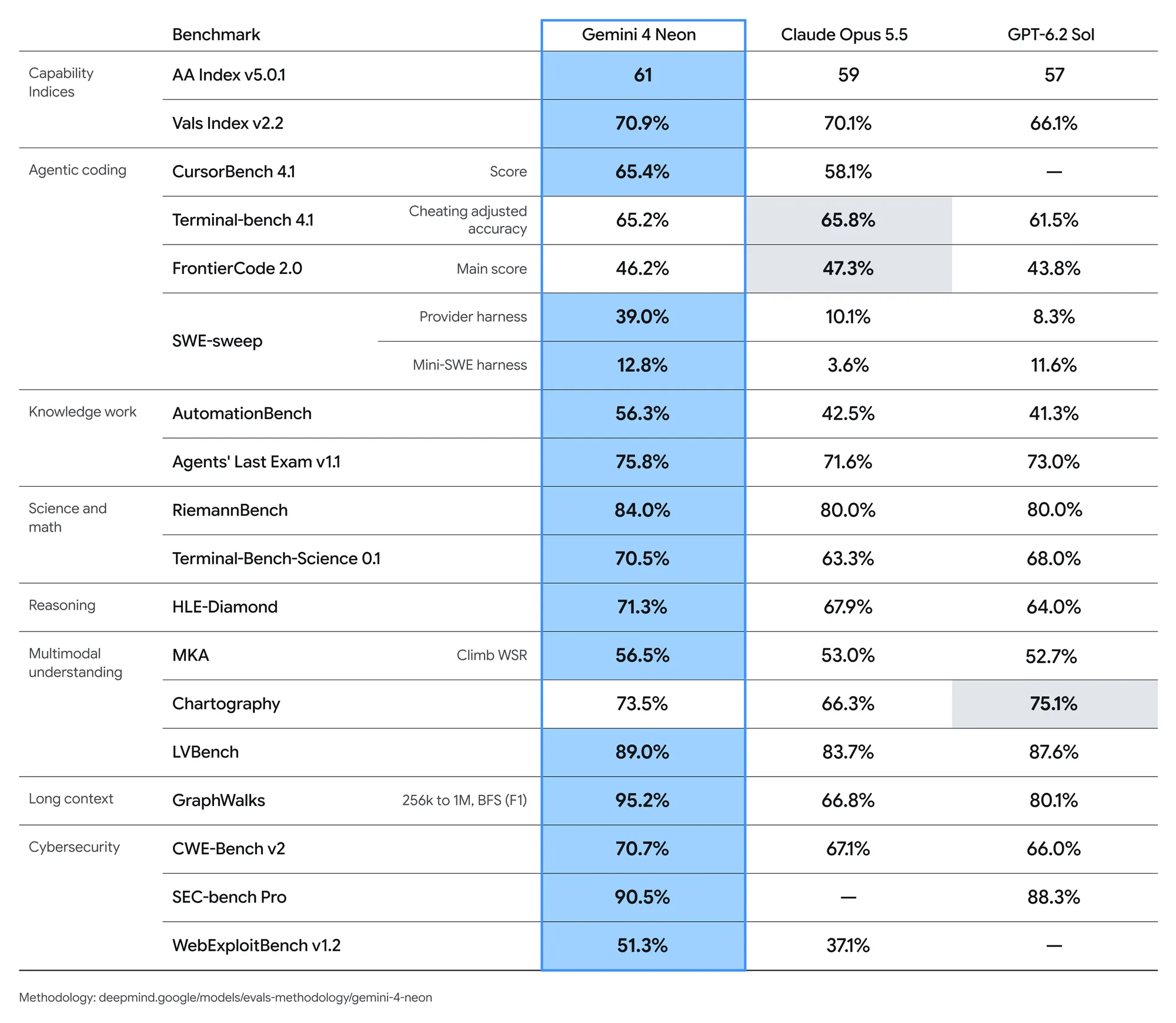
The attached benchmark table lines Neon up against Claude Opus 5.5 and GPT-6.2 Sol, and the wins cover most of it: AA Index 61 against 59 and 57; Vals Index 70.9% against 70.1% and 66.1%; CursorBench 4.1 65.4%; AutomationBench 56.3%; Agents' Last Exam v1.1 75.8%; RiemannBench 84.0%; Terminal-Bench-Science 70.5%; HLE-Diamond 71.3%; LVBench 89.0%; long-context GraphWalks (256k to 1M, BFS F1) 95.2% against 66.8% and 80.1%; and all three cybersecurity rows — CWE-Bench v2 70.7%, SEC-bench Pro 90.5%, WebExploitBench v1.2 51.3%. The post adds: #1 on most Surge AI categories across finance, accounting, spreadsheet modeling and complex constraints; #1 on both the Legal Research Bench and Tax Agent Bench; an Agent Arena Index debut of 1336 at #2 across 4,200+ real sessions with #2 steerability; and #1 on Vending-Bench 2 ($16,843).
The same table marks three losses in grey, and they should travel with any citation: Terminal-Bench 4.1 (cheating-adjusted accuracy) at 65.2%, below Opus 5.5's 65.8%; FrontierCode 2.0's main score at 46.2%, below Opus 5.5's 47.3%; Chartography at 73.5%, below GPT-6.2 Sol's 75.1%. "A mid-tier that passes the leaders on the composite" and "still loses named rows one by one" hold at once, and the official table draws both layers itself — which makes it more citable, not less.
One row deserves its own explanation, because the official text puts the same model in two harnesses side by side: 12.8% on the mini-SWE harness against 39.0% inside Google Antigravity — a threefold gap attributable to the scaffolding, not the model, and the announcement does not hide the pairing ("showing what the Antigravity harness unlocks"). For anyone reading benchmarks, that is the round's most practical lesson: the same model can reorder a board when the harness changes; ask which scaffold produced a score before comparing. The remaining coding caliber (vendor-assessed): Terminal-Bench 4.1 at 65.2%, FrontierCode 2.0 at 46.2% (high), and "surgical" multi-file debugging and cross-repository refactoring.
The safety figures are all vendor caliber, quoted as given: the Gemini 4 safety stack carries over, keeping Carbon-level protections against severe misuse and prompt injection while refusing far less — 1.98% of tasks refused on Terminal-Bench 4.0 and 0% on Terminal-Bench-Science; in internal coding use, alert rates from the chain-of-thought and action misalignment monitor stayed below Carbon's already low baselines; 0.0% cheating on Terminal-Bench 4.0; 2.45% shortcuts on the coding cheating evaluation (the family's lowest by the official count); a 0.09% misaligned-action rate on the agentic safety suite; a 99.2% pass on the agent honesty evaluation; under-service down 43–56% and overreach down 15–35% versus Carbon across effort levels; and 0.0% attack success on Gray Swan's indirect-prompt-injection benchmark at the highest thinking level with real-time safeguards (previously reached only by other Gemini models, per the note). The cyber edition "Neon for cyber" is not in this batch's public entry points — it reaches trusted defenders via the Fairwind Program over the coming days, requested through a Cloud account team. The methodology page travels with the post (deepmind.google/models/evals-methodology/gemini-4-neon); this site has not checked it line by line.
Sources and further reading
- Google's official announcement: Introducing Gemini 4 NeonOfficial release · page dated November 18, 2026 · read in full by this site on November 19Read in full. Checked the key contents: positioned for "frontier-level intelligence with fast end-to-end task completion across complex software engineering, knowledge work, and science workflows"; AA Intelligence Index 61 at xhigh, #3 overall ("just behind larger, slower models"); #1 on the AA Coding Agent Index (58.6); #2 on the Vals Index (70.9%) on the Pareto frontier, #1 on both the Legal Research Bench and Tax Agent Bench; Agent Arena Index debut at #2 (1336 across 4,200+ real sessions), #2 steerability; Surge AI #1 on most of finance, accounting, spreadsheet modeling and complex constraint following; Chartography 73.5%; Agents' Last Exam v1.1 75.8%; Zapier AutomationBench #1 (56.3%); Vending-Bench 2 #1 ($16,843); Terminal-Bench Science 70.5%, RiemannBench 84.0%, HLE-Diamond 71.3%. Pricing: $3 / $0.15 cached (95% discount) / $15 per million tokens, 1M context. Access: Gemini API paid tier (AI Studio, Android Studio), Antigravity (Pro/Ultra), AI Studio (Pro/Ultra), Gemini for business (API and model dropdown), the Gemini app (Pro/Ultra dropdown); the Fairwind cyber edition in the coming days. Official efficiency caliber (vendor-assessed): 32% lower cost per task than Carbon at high; Pareto frontier on Vals and Agent Arena at 50–80% below top frontier models per task; xhigh still 36%+ cheaper than competitors' highest settings. Coding: Terminal-Bench 4.1 65.2%, FrontierCode 2.0 46.2% (high), SWE-sweep 12.8% on the mini-SWE harness against 39.0% inside Antigravity (the harness gap is given side by side in official text); can act as an Orchestrator directing parallel Hydrogen subagents in Antigravity, cutting redundant file reads, sharing progress and compacting context reliably. Cyber (Neon for cyber): AutoBaxBench hard tier 76% SOTA (ahead of Carbon across easy/medium/hard); WebExploitBench v1.2 51.26% SOTA at about half the cost of competing large models; SEC-bench Pro 90.5% SOTA at roughly half the cost per challenge; ExploitGym at frontier level with half the tokens of Carbon; CWE-bench v2 70.7% (+3.4% over Carbon). Safety: Carbon-level protections against severe misuse and prompt injection; refusals of just 1.98% on Terminal-Bench 4.0 and 0% on Terminal-Bench-Science; chain-of-thought and action misalignment monitor alert rates below Carbon's baselines; 0.0% cheating on Terminal-Bench 4.0 and 2.45% shortcuts on the coding cheating evaluation (the family's lowest); 0.09% misaligned-action rate; 99.2% pass on the agent honesty evaluation; under-service down 43–56% and overreach down 15–35% versus Carbon across effort levels; 0.0% attack success on Gray Swan's IPI benchmark at xhigh with real-time safeguards (previously reached only by other Gemini models). Tasks in the Gemini app can now run on Neon. The model card is linked from the post (not read by this site).
Family structure and the price ladder: what a mid-tier is for
Read the family's four rows together and Neon fills the layer between subscription and price. The official chart: Carbon serves Google AI Ultra only ($4/$20, with a $2/$10 promotional price through November 30); Neon serves Pro and Ultra ($3/$15); Hydrogen is for everyone ($1.50/$7.50 flat to 1M). The speed row's rocket count runs three tiers as well — Carbon two, Neon three and a half, Hydrogen five. This is the family's fourth member and third new tier since September 30, and the first time the official chart itself shows a mid-tier outscoring the flagship — the Quality row reads 60 / 61 / 54 exactly.
The ladder's relative position matters more than the absolute numbers: Neon's $3/$15 sits between Hydrogen's $1.50/$7.50 and Carbon's $4/$20, while its $0.15 cached rate pushes the cost of "an agent rereading the same files in a long context" to the family's floor — against Astra's $0.40 cached rate and Carbon's (list cached price not published separately; the promotional $2/$10 runs to November 30). For usage-billed developers, a mid-tier's point is not "a cheaper flagship" but the unit cost of high-frequency complex work: officially 32% below Carbon per task at high, and still 36%+ below competitors' top settings at xhigh. The logic points the same way as GPT-6.2 Astra's "capability up, input/output −20%, cached −60%": the mid-band across all three providers is compressing toward "the same tasks, cheaper".
Sources and further reading
- Google's official announcement: Introducing Gemini 4 NeonOfficial release · page dated November 18, 2026 · read in full by this site on November 19Read in full. Checked the key contents: positioned for "frontier-level intelligence with fast end-to-end task completion across complex software engineering, knowledge work, and science workflows"; AA Intelligence Index 61 at xhigh, #3 overall ("just behind larger, slower models"); #1 on the AA Coding Agent Index (58.6); #2 on the Vals Index (70.9%) on the Pareto frontier, #1 on both the Legal Research Bench and Tax Agent Bench; Agent Arena Index debut at #2 (1336 across 4,200+ real sessions), #2 steerability; Surge AI #1 on most of finance, accounting, spreadsheet modeling and complex constraint following; Chartography 73.5%; Agents' Last Exam v1.1 75.8%; Zapier AutomationBench #1 (56.3%); Vending-Bench 2 #1 ($16,843); Terminal-Bench Science 70.5%, RiemannBench 84.0%, HLE-Diamond 71.3%. Pricing: $3 / $0.15 cached (95% discount) / $15 per million tokens, 1M context. Access: Gemini API paid tier (AI Studio, Android Studio), Antigravity (Pro/Ultra), AI Studio (Pro/Ultra), Gemini for business (API and model dropdown), the Gemini app (Pro/Ultra dropdown); the Fairwind cyber edition in the coming days. Official efficiency caliber (vendor-assessed): 32% lower cost per task than Carbon at high; Pareto frontier on Vals and Agent Arena at 50–80% below top frontier models per task; xhigh still 36%+ cheaper than competitors' highest settings. Coding: Terminal-Bench 4.1 65.2%, FrontierCode 2.0 46.2% (high), SWE-sweep 12.8% on the mini-SWE harness against 39.0% inside Antigravity (the harness gap is given side by side in official text); can act as an Orchestrator directing parallel Hydrogen subagents in Antigravity, cutting redundant file reads, sharing progress and compacting context reliably. Cyber (Neon for cyber): AutoBaxBench hard tier 76% SOTA (ahead of Carbon across easy/medium/hard); WebExploitBench v1.2 51.26% SOTA at about half the cost of competing large models; SEC-bench Pro 90.5% SOTA at roughly half the cost per challenge; ExploitGym at frontier level with half the tokens of Carbon; CWE-bench v2 70.7% (+3.4% over Carbon). Safety: Carbon-level protections against severe misuse and prompt injection; refusals of just 1.98% on Terminal-Bench 4.0 and 0% on Terminal-Bench-Science; chain-of-thought and action misalignment monitor alert rates below Carbon's baselines; 0.0% cheating on Terminal-Bench 4.0 and 2.45% shortcuts on the coding cheating evaluation (the family's lowest); 0.09% misaligned-action rate; 99.2% pass on the agent honesty evaluation; under-service down 43–56% and overreach down 15–35% versus Carbon across effort levels; 0.0% attack success on Gray Swan's IPI benchmark at xhigh with real-time safeguards (previously reached only by other Gemini models). Tasks in the Gemini app can now run on Neon. The model card is linked from the post (not read by this site).
- The Artificial Analysis intelligence board (this site's direct full fetch)Independent evaluation · direct fetch by this site on November 19, 2026Direct fetch and checked. The source table adds four Gemini 4 Neon rows: Xhigh 61 (61.40) / High 60 (59.62) / Medium 55 (54.86) / Low 44 (44.08); the embedded metadata reads releaseDate 2026-11-18, deprecated: false, isReasoning: true, a 1,000,000-token context window, creator Google. The visible main table renders one row per model with the effort inline — Neon shows "Gemini 4 Neon Xhigh 61", sorted after GPT-6.2 Astra (Max 62) and before Carbon (High 60). All other 36 catalogued rows keep their highest-tested scores and settings (Fable 5.2 leads at max 65); the retired rows (GPT-6 Astra, GPT-6.1 Sol, Qwen3.8 Max 0902, Gemini 3.8 Flash) remain absent; uncatalogued rows (Inkling 2 Small 31, Agnes 2.5 Pro Theta 24, DeepSeek V4 Pro 0813 23, Nanbeige4.3-33B 20, the K2 Horizon family, JoyAI-VL-Preview 28 and others) stay outside as usual; the Grok 4.7 row displays Xhigh 35 (consistent with the November 16 note, value unchanged).
What readers can check next
Split the next checkable points by audience. On the board: whether 61 holds — the five-deep board head (65/62/61/60/59) gets re-read every maintenance round, and Neon's four effort rows and their display values stay under version watch; whether Carbon gains an xhigh tier is the family structure's own next data point (its ladder stops at high today). On access: real visibility of the Pro/Ultra dropdown in the Gemini app, the feel of the Orchestrator (Neon directing Hydrogen subagents) in Antigravity, and the completion quality of Tasks in the Gemini app once they run on Neon — this site tracks the Tasks line continuously, and how "multistep jobs on a mid-tier" pencils out rejoins it when checkable material lands. On cybersecurity: the pace at which Fairwind admits trusted defenders to "Neon for cyber".
Finally, the boundaries. This site ran no model and reproduced no benchmark; all official efficiency, benchmark and safety figures are vendor caliber, with the methodology page and model card not checked line by line; SWE-sweep's 39.0% comes from the Antigravity harness and 12.8% from mini-SWE — read the scaffold before citing either cell; the AA 61/60/55/44 are this site's independent direct-fetch readings of November 19 and do not substitute for the self-reported figures; the index mainly measures English text tasks, so Chinese and multimodal performance needs separate evaluation. For the family itself, one observation: after three new tiers in 21 days, the matrix of four models, three subscription bands and four thinking levels is full — what fills the next cell, "Carbon gains xhigh" or a finer split of the mid-band, is an answer the family chart itself will give.
- Read Google's full announcementPositioning, every benchmark figure, the official benchmark table and family chart, pricing and access, and the safety and behavior figures; the model card and methodology page links travel with the text.
- See our model pageNeon's catalogue entry, its AA row configuration note and the family's four-tier comparison; the Carbon page lives at /models/gemini-4-carbon, Hydrogen at /models/gemini-4-hydrogen.
- Compare the full AA board as we track itThe 38 catalogued models and each board's rules; the 61/62/60/65/59 board head and the four retired rows preserved in records.
Sources and further reading
- Google's official announcement: Introducing Gemini 4 NeonOfficial release · page dated November 18, 2026 · read in full by this site on November 19Read in full. Checked the key contents: positioned for "frontier-level intelligence with fast end-to-end task completion across complex software engineering, knowledge work, and science workflows"; AA Intelligence Index 61 at xhigh, #3 overall ("just behind larger, slower models"); #1 on the AA Coding Agent Index (58.6); #2 on the Vals Index (70.9%) on the Pareto frontier, #1 on both the Legal Research Bench and Tax Agent Bench; Agent Arena Index debut at #2 (1336 across 4,200+ real sessions), #2 steerability; Surge AI #1 on most of finance, accounting, spreadsheet modeling and complex constraint following; Chartography 73.5%; Agents' Last Exam v1.1 75.8%; Zapier AutomationBench #1 (56.3%); Vending-Bench 2 #1 ($16,843); Terminal-Bench Science 70.5%, RiemannBench 84.0%, HLE-Diamond 71.3%. Pricing: $3 / $0.15 cached (95% discount) / $15 per million tokens, 1M context. Access: Gemini API paid tier (AI Studio, Android Studio), Antigravity (Pro/Ultra), AI Studio (Pro/Ultra), Gemini for business (API and model dropdown), the Gemini app (Pro/Ultra dropdown); the Fairwind cyber edition in the coming days. Official efficiency caliber (vendor-assessed): 32% lower cost per task than Carbon at high; Pareto frontier on Vals and Agent Arena at 50–80% below top frontier models per task; xhigh still 36%+ cheaper than competitors' highest settings. Coding: Terminal-Bench 4.1 65.2%, FrontierCode 2.0 46.2% (high), SWE-sweep 12.8% on the mini-SWE harness against 39.0% inside Antigravity (the harness gap is given side by side in official text); can act as an Orchestrator directing parallel Hydrogen subagents in Antigravity, cutting redundant file reads, sharing progress and compacting context reliably. Cyber (Neon for cyber): AutoBaxBench hard tier 76% SOTA (ahead of Carbon across easy/medium/hard); WebExploitBench v1.2 51.26% SOTA at about half the cost of competing large models; SEC-bench Pro 90.5% SOTA at roughly half the cost per challenge; ExploitGym at frontier level with half the tokens of Carbon; CWE-bench v2 70.7% (+3.4% over Carbon). Safety: Carbon-level protections against severe misuse and prompt injection; refusals of just 1.98% on Terminal-Bench 4.0 and 0% on Terminal-Bench-Science; chain-of-thought and action misalignment monitor alert rates below Carbon's baselines; 0.0% cheating on Terminal-Bench 4.0 and 2.45% shortcuts on the coding cheating evaluation (the family's lowest); 0.09% misaligned-action rate; 99.2% pass on the agent honesty evaluation; under-service down 43–56% and overreach down 15–35% versus Carbon across effort levels; 0.0% attack success on Gray Swan's IPI benchmark at xhigh with real-time safeguards (previously reached only by other Gemini models). Tasks in the Gemini app can now run on Neon. The model card is linked from the post (not read by this site).
- The Artificial Analysis intelligence board (this site's direct full fetch)Independent evaluation · direct fetch by this site on November 19, 2026Direct fetch and checked. The source table adds four Gemini 4 Neon rows: Xhigh 61 (61.40) / High 60 (59.62) / Medium 55 (54.86) / Low 44 (44.08); the embedded metadata reads releaseDate 2026-11-18, deprecated: false, isReasoning: true, a 1,000,000-token context window, creator Google. The visible main table renders one row per model with the effort inline — Neon shows "Gemini 4 Neon Xhigh 61", sorted after GPT-6.2 Astra (Max 62) and before Carbon (High 60). All other 36 catalogued rows keep their highest-tested scores and settings (Fable 5.2 leads at max 65); the retired rows (GPT-6 Astra, GPT-6.1 Sol, Qwen3.8 Max 0902, Gemini 3.8 Flash) remain absent; uncatalogued rows (Inkling 2 Small 31, Agnes 2.5 Pro Theta 24, DeepSeek V4 Pro 0813 23, Nanbeige4.3-33B 20, the K2 Horizon family, JoyAI-VL-Preview 28 and others) stay outside as usual; the Grok 4.7 row displays Xhigh 35 (consistent with the November 16 note, value unchanged).