Material and results · Document checks
What can AI check first in a technical document?
Deep Review checks a long document in sections, then brings the findings together. Authors' pre-submission accounts show how feedback can lead to stronger arguments and new experiments, with each critique still needing a human check.
Google announced public access to Deep Review on October 14. This reading starts with authors' experiences of its earlier PAT system, then checks the current entry. BitShovel inspected it anonymously, without signing in, uploading a document or generating a review.
Which part of a draft does useful feedback change?
In ICML's pilot retrospective, author Apoorv Varshney describes feedback on contradictions in objective functions, inconsistent problem definitions and unsupported experimental claims. Such points give an author specific places to revisit: a definition, a derivation or a result supporting a conclusion. This is his published account; the retrospective does not provide his complete manuscript and review.
This follows a question that arises after material becomes a report or proposal: does an important sentence have support elsewhere in the document? Feedback that names a location and explains its concern gives the author something concrete to work through.
Sources and further reading
- ICML · PAT pre-submission pilot retrospectiveConference/Google joint account · March 30, 2026About 4,500 manuscripts and 869 survey responses. Theory and experimental findings concern the applicable respondent groups, rather than an independent accuracy test.
Check each section while keeping the whole in view
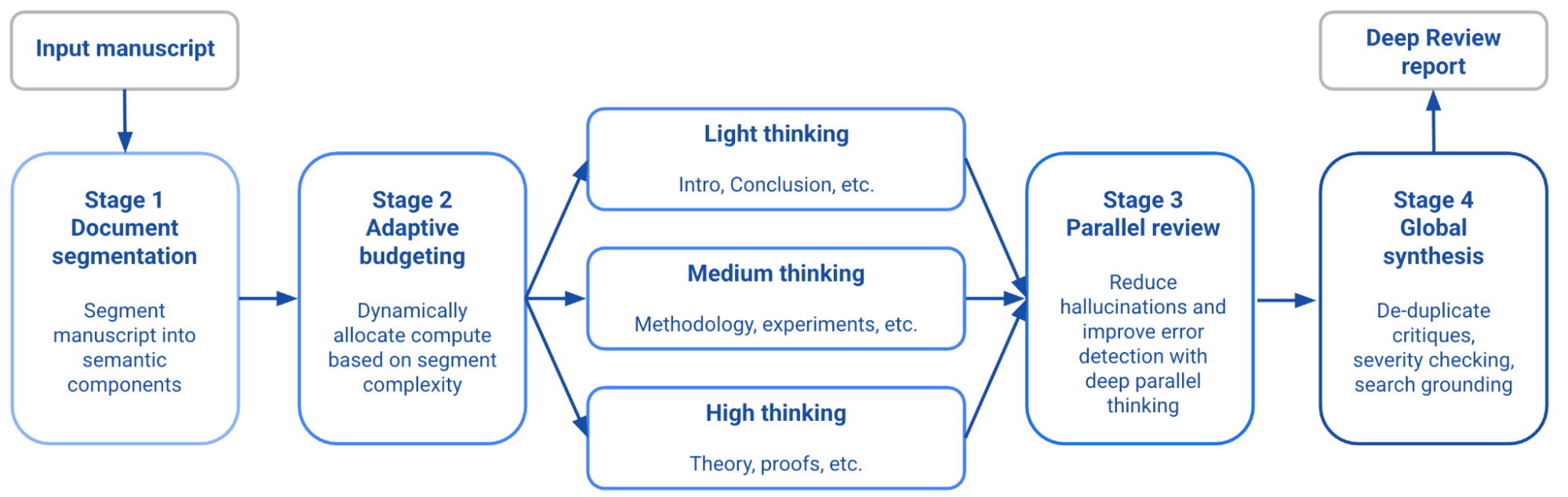
Google describes a pipeline that segments the document and allocates more computation to difficult proofs or analysis. Each section's agent retains the whole document as context, helping it follow connections among definitions, experiments and conclusions. A synthesis agent then merges and deduplicates findings and checks external grounding through search.
The paper explains why orchestration matters: repeated whole-document calls can revisit the same passages while producing more suspected issues for a person to sift through. Dividing the work and checking the combined findings aims to cover different parts of the document; the process does not guarantee every criticism is valid.
Sources and further reading
- Google Research · Deep Review public releaseOfficial announcement · October 14, 2026The four-stage pipeline, initial PDF/text input and planned multi-file support. Proposed uses remain distinct from demonstrated results.
- PAT · Method, early tests and limitationsAuthors' paper · First submitted June 26, 2026How section checks retain full-document context, plus parsing, factual and false-critique limitations. The earlier system is distinct from the current Argon version.
What does an author's decision to run more experiments show?
ICML's March 30 retrospective describes feedback on about 4,500 manuscripts in January, followed by 869 survey responses. Among respondents whose papers contained theory, 35.4% reported significant gaps taking over an hour to fix. Among those with experimental results, 31% said feedback prompted new experiments. These concern different groups' revision experiences, rather than an error rate across all manuscripts or system accuracy.
Pilot feedback went only to authors and was separate from formal peer review, invisible to reviewers and conference decision-makers. It supports a pre-submission use: surface another set of questions for the author to check and address. The paper also records PDF-parsing problems, factual hallucinations and mistaken critiques of valid arguments. These earlier findings are not a controlled evaluation of today's Gemini 4 Argon version.
Sources and further reading
- PAT · Method, early tests and limitationsAuthors' paper · First submitted June 26, 2026How section checks retain full-document context, plus parsing, factual and false-critique limitations. The earlier system is distinct from the current Argon version.
- ICML · PAT pre-submission pilot retrospectiveConference/Google joint account · March 30, 2026About 4,500 manuscripts and 869 survey responses. Theory and experimental findings concern the applicable respondent groups, rather than an independent accuracy test.
Start with a document you can check
The October 16 anonymous inspection found a Google sign-in requirement, Upload document and Paste text options, and optional context. The October 14 announcement lists initial PDF and plain-text inputs, with multi-file support planned. The current FAQ also lists Google Docs and Google Slides. BitShovel has not tested importing or processing those formats, or joint review of multiple files.
The page offers two free reviews per week using Gemini 4 Argon on Medium. Beyond that, a personal Gemini API key pays for the underlying model usage. The current entry says documents are retained for up to one year for viewing and are not used for model training without permission; its FAQ also describes an optional permission to let researchers use data to improve Deep Review. Consider the allowance, computation cost and retention together.
An editorial starting point is a draft you are entitled to submit and whose evidence you can revisit. Pick a sentence central to its conclusion: does the feedback locate the passage, explain the missing support and suggest a check? Return to the material before deciding whether to revise. BitShovel has not uploaded a draft or generated a report. The AstaBrief reading continues with how a report's citations retain people, dates and conditions.
- Open Deep Review and its FAQ
- Read the original ICML author-feedback account
- Follow a cited report back to its original paper
Sources and further reading
- Google Research · Deep Review public releaseOfficial announcement · October 14, 2026The four-stage pipeline, initial PDF/text input and planned multi-file support. Proposed uses remain distinct from demonstrated results.
- Deep Review · Current entry and FAQProduct page · Inspected anonymously October 16, 2026Sign-in, document upload and pasted text, two free weekly reviews, API-key billing and document retention. No material was submitted.