Work is changing · From output to human judgment
Why do Anthropic employees meet more as AI does more work?
An internal study connects code, hiring, agent sessions and calendars. Faster output leaves people judging results, coordinating and updating context. What does the evidence show, and what remains uncertain?
The report is dated October 16; its structured publication time falls on October 17 in Beijing. This reading checks the original report and figures October 18. Company records, surveys and 17 employee interviews cover several windows in 2025–2026. One fast-growing company using its own AI intensively does not represent the whole labor market.
Output accelerates; shared decisions remain
In the report, a salesperson describes building a dashboard in three or four hours that previously felt beyond their reach. Code commits, processed contracts and closed deals also rose. Calendar records meanwhile show a 20% increase in median meeting time from a year earlier, and a 16% rise for technical individual contributors. More output can coexist with decisions about direction, dependencies and responsibility.
Interviewees describe bugs exposing organizational boundaries, technical debt or decisions that require people to convene. Company growth and changing job composition also contribute to meeting trends. The study does not establish that AI necessarily causes more meetings, or that more meetings improve outcomes.
Sources and further reading
- Anthropic · How employment is changing at AnthropicOriginal research · October 16 at source / October 17 in Beijing; checked October 18An internal-data study by Wilmers, Catipon, Massenkoff and McCrory, including 17 interviews, figures and methods; BitShovel did not access employee microdata or independently replicate the analysis.
After faster generation, who decides what deserves attention?
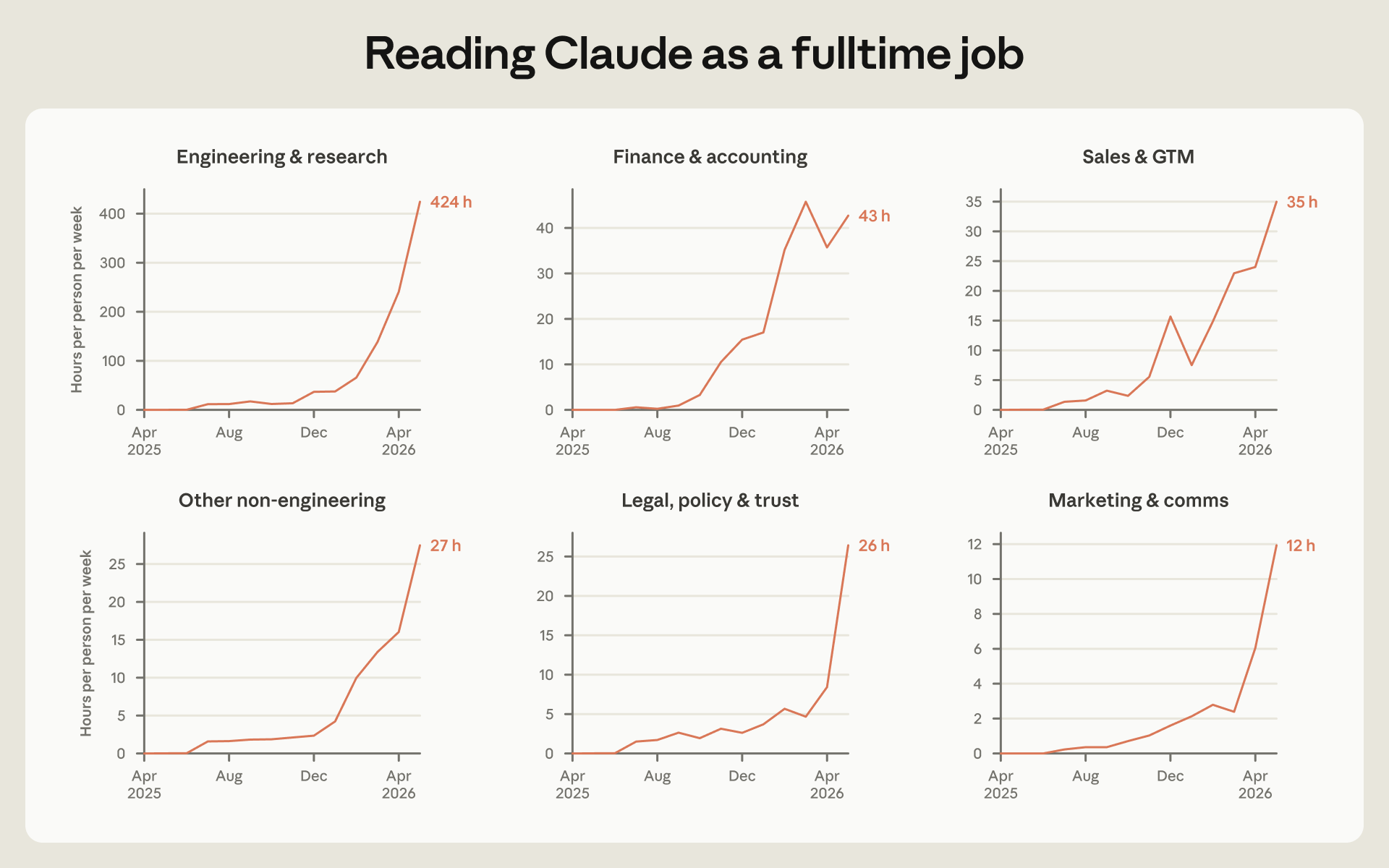
For some non-technical functions, reading every word from interactive Claude sessions would require more than twenty hours a week. This is a calculation from output volume and a fixed reading speed, not measured employee reading time. The practical question becomes which results need inspection, which requests are urgent and which can be handled by another tool.
Two other striking figures use different units. By August, employee-directed interactive agent runtime, pooling subagents and counting inference and tool work while excluding waits over thirty minutes, was about six times human hours estimated at forty per employee per week; this is not six times the workforce. Interactive sessions spent about 80% of elapsed time waiting for input, which does not mean 80% of the company’s work time was wasted. Runtime, waiting, reading and useful results measure different things.
Sources and further reading
- Anthropic · How employment is changing at AnthropicOriginal research · October 16 at source / October 17 in Beijing; checked October 18An internal-data study by Wilmers, Catipon, Massenkoff and McCrory, including 17 interviews, figures and methods; BitShovel did not access employee microdata or independently replicate the analysis.
Some human work moves between agents and into shared context
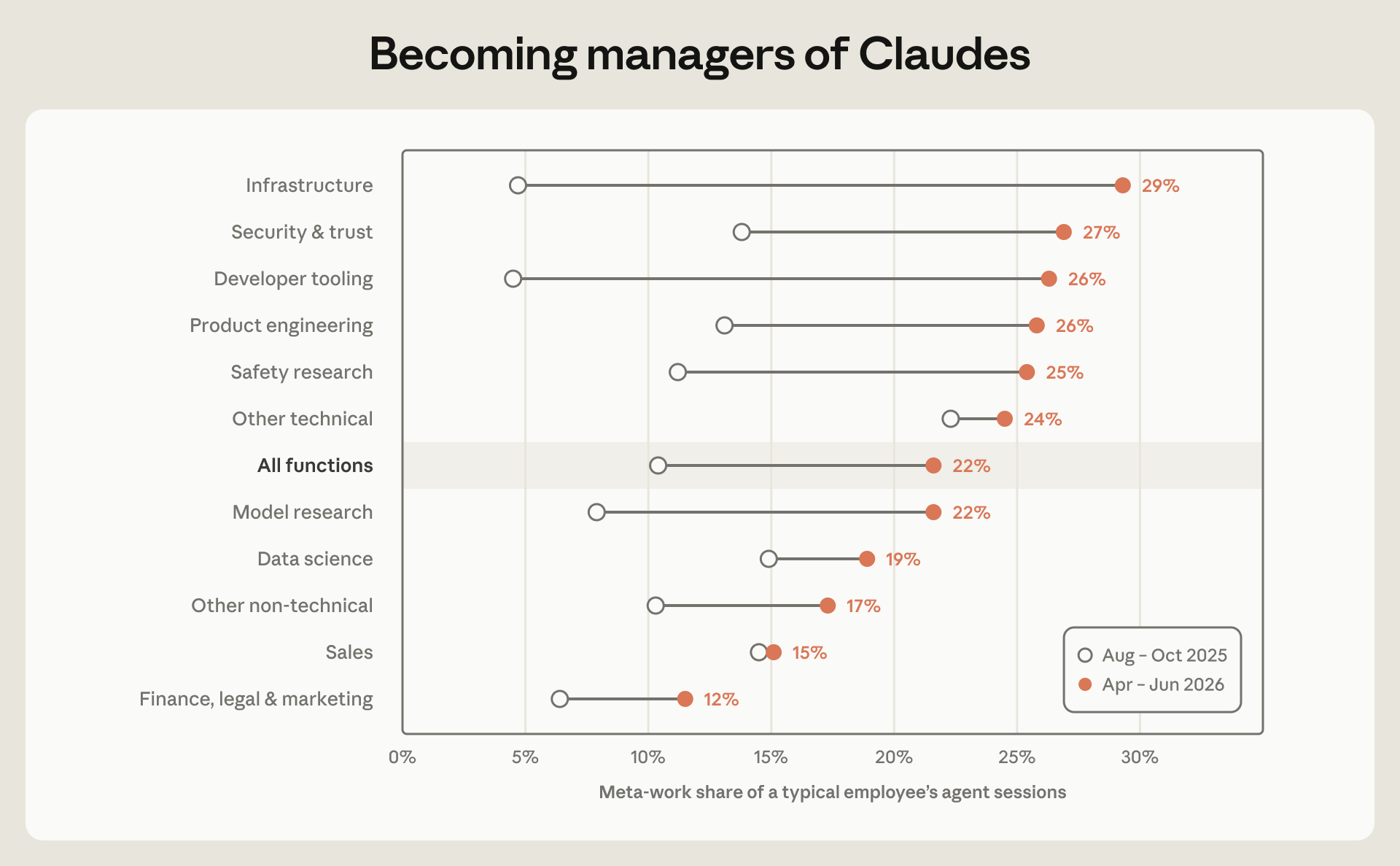
The report groups agent instructions, multi-agent plans, reviews and monitoring dashboards as meta-work. Automated analysis of chat summaries places it at about 10% of a typical employee’s interactive sessions in fall 2025 and 22% in spring 2026. This describes how the organization handles output, without assigning the same share of business value to that coordination work.
Context must change with people. One interviewee kept receiving agent requests about shirts and mugs because their name remained on an old merchandise document after their responsibilities changed. In one department’s communication analysis, agents added exchanges without materially shrinking the underlying human interaction structure. Recording decisions, owners and changes in shared material becomes part of coordination; more old documents do not necessarily provide fresher context.
Sources and further reading
- Anthropic · How employment is changing at AnthropicOriginal research · October 16 at source / October 17 in Beijing; checked October 18An internal-data study by Wilmers, Catipon, Massenkoff and McCrory, including 17 interviews, figures and methods; BitShovel did not access employee microdata or independently replicate the analysis.
Hiring changes, with limits on what the case establishes
Since early 2025, junior staff fell from 21% to 14% of technical employment, and from 27% to 9% of new technical hires, while technical hiring still grew in absolute terms. Falling shares do not establish equivalent layoffs. The output analysis follows 192 engineers adopting coding agents against 74 who did not adopt during the study. Adoption was not random: people preparing major projects may adopt earlier, and autonomous-agent adopters were already increasing their output.
For your own work, ask whether less execution time creates new reviewing, communication and context-maintenance tasks; whether the final result is dependable; and how newcomers still participate and develop judgment. Code volume, agent runtime and meeting time alone cannot answer those questions. These are ways to examine one company’s experience, rather than a prescription to copy its organization or a promise of saved hours.
Sources and further reading
- Anthropic · How employment is changing at AnthropicOriginal research · October 16 at source / October 17 in Beijing; checked October 18An internal-data study by Wilmers, Catipon, Massenkoff and McCrory, including 17 interviews, figures and methods; BitShovel did not access employee microdata or independently replicate the analysis.