Trail of Bits researcher report · Published 2026-08-27
Trail of Bits: what its VM isolation experiment showed
Trail of Bits challenged VM isolation on a development machine using GPT 5.6-Cyber. The report covers old vulnerabilities, patch delivery and new findings, but the three stages have different outcomes and should not be summarized as three completed escapes.
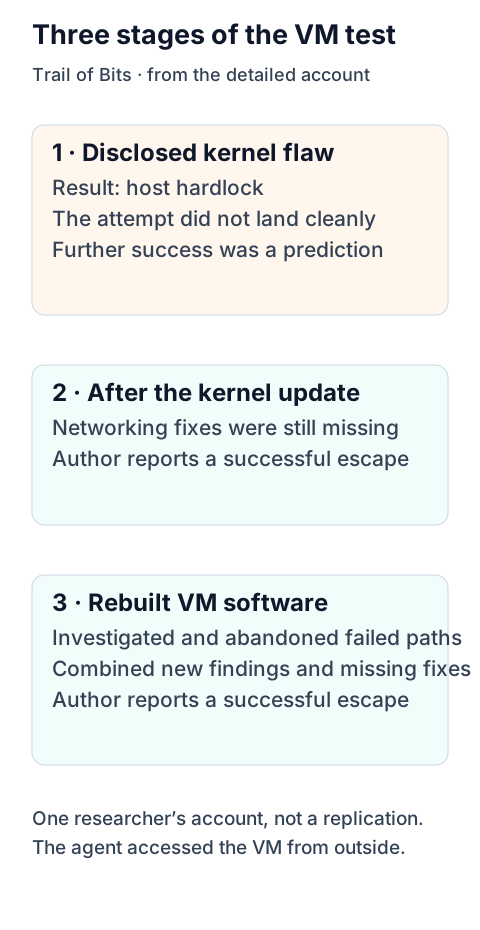
Read the outcomes of the three stages separately
The researcher used a QEMU/KVM VM on a Debian 12, AMD Zen3 development machine and tasked the agent with escaping and reading a flag file. The agent ran outside the VM and accessed the target through SSH. The author explains that this retained the research process when the VM crashed and says the final exploit could be audited for cheating. This is not a systematic evaluation with the whole agent confined inside the VM.
The first stage targeted a disclosed host-kernel vulnerability and hardlocked the machine after about an hour. Although the introduction claims three escapes, the detailed section says this attempt did not land cleanly. The author’s confidence that further revision would work is not a reported flag read. After the kernel update, the second stage combined flaws in the libslirp networking dependency; the author reports an escape.
For the third stage, the author rebuilt newer QEMU and dependencies. Across roughly twelve hours of investigation, the agent abandoned unsuccessful paths before reportedly combining three vulnerabilities that were zero-days when found and a fix missing from the distribution. This illustrates persistent investigation and the gap that can remain between installed packages and upstream fixes.
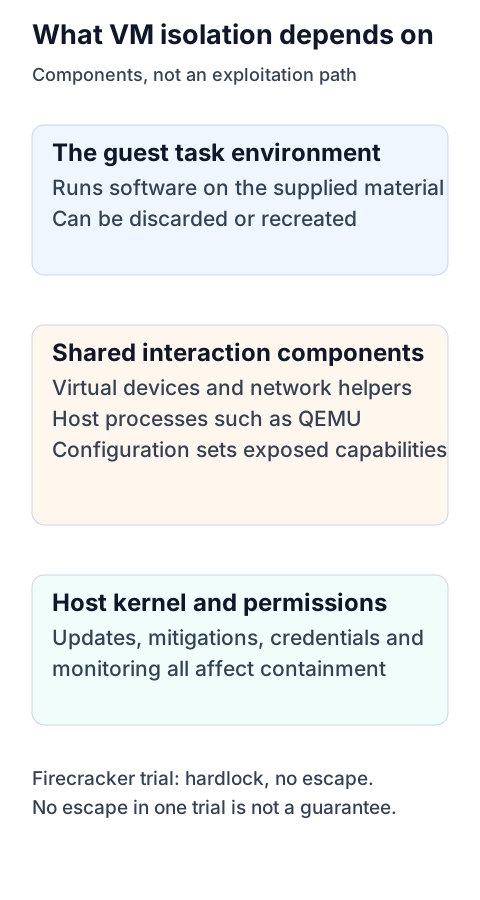
What belongs inside the isolation boundary
Virtual devices, networking and host software make a VM usable and form part of the boundary that must be maintained. This experiment also has specific conditions: the host disabled some kernel mitigations, several approaches failed, and the outcomes come from the researcher’s account on one machine. It does not establish that every VM, model or vendor configuration has failed.
In a separate Firecracker attempt, the author reports another host hardlock but no successful escape. That motivates further investigation of smaller attack surfaces and timely updates; it does not establish permanent safety. The report’s operational directions include fewer exposed network and device capabilities, restricted credentials, logging, active monitoring and fresh environments with bounded task lifetimes.
BitShovel has corrected the three-successes summary against the detailed account while preserving the source and original dates. The diagrams distinguish stage outcomes from shared isolation components. There is no independent reproduction here, and the author’s predictions are not counted as completed escapes.
Important additions and corrections
Dates below mark changes to our coverage.
- Correction ·
Distinguished host hardlocks from completed escapes, corrected the three-successes claim and added experimental conditions and the Firecracker comparison.
Sources and notes
sources中文
Sources and notes
- Read the originalTrail of Bits researcher report
Retained summary and context
GPT 5.6-Cyber accessed the QEMU/KVM target through SSH. The first attempt did not land cleanly and hardlocked the host; the post-kernel-update and rebuilt-QEMU stages report escapes. Outcomes depend on this host, its dependencies, permissions and mitigations and do not generalize directly to all VMs.
This is a researcher account on one development machine, not a systematic benchmark or BitShovel replication. Stage one records a hardlock; the later stages report escapes. The agent ran outside the VM and some host mitigations were disabled.
Sources and evidence · 2 links
Each link has a purpose and scope. Link counts do not establish independent confirmation; direct support applies only to the statements specified below.
Source timeline
- · Entered the BitShovel radar: 25 entries in the current Lobsters front page feed.
Collection record
First discovered:
Collection and source publication have distinct dates.
Editorial record
Corrected
· Beijing time (UTC+8)
Distinguished host hardlocks from completed escapes, corrected the three-successes claim and added experimental conditions and the Firecracker comparison. Event, discovery and collection dates remain unchanged.
Sources and full record
This dates our review of the wording and sources, not a project release or product update.
Full record: before, after and sources (JSON)