TechCrunch · pre-launch reporting · Published 2026-09-03
Astra reasoning report: why monitorability matters
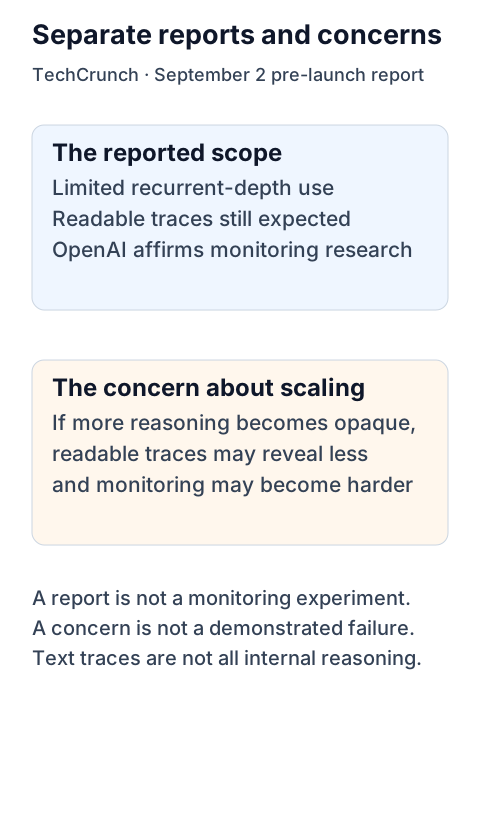
TechCrunch’s September 2 report said Astra made limited use of recurrent depth. Researchers worried that moving more computation into opaque internal loops could reduce the clues available in readable chains of thought. This was pre-launch reporting and discussion, not proof that monitoring had failed.

Readable steps can provide monitoring clues
Textual chains of thought expose intermediate steps that can help researchers investigate unusual behavior or departures from a task. The report describes recurrent depth, also called opaque recurrence, as repeated internal processing. This is a conceptual account, not enough information to reconstruct Astra’s complete architecture.
Redwood researchers expressed concern about scaling opaque reasoning further. The same article said Astra’s use was limited, that readable chains of thought were still expected, and that OpenAI remained committed to monitoring research. A concern about future scaling does not establish that the current model is unmonitorable.
What would establish a monitoring difference?
A chain of thought is not a faithful transcript of every internal computation. Readable text can offer clues without exposing the entire process. Useful comparisons would hold tasks and settings comparable while measuring answer quality, latency and detection of abnormal behavior. A technique’s name or an isolated trace establishes neither safety nor danger.
This record retains the September 2 report and its status. Later releases, work examples and monitoring developments continue in the Astra topic. BitShovel has neither an internal architecture specification nor a monitoring experiment that would turn the report’s possibilities into confirmed outcomes.
Important additions and corrections
Dates below mark changes to our coverage.
- Correction ·
Clarified recurrent depth terminology, restored pre-launch attribution and limited use, and distinguished future concerns from demonstrated outcomes.
- Correction ·
Withdrew a value claim not grounded in a specific use case; the source note still needs evidence of practical use.
Sources and notes
sources中文
Sources and notes
- Read the originalTechCrunch · pre-launch reporting
Retained summary and context
The pre-launch report describes limited use. Researchers’ concerns about scaling opaque computation are not demonstrated monitoring failure; BitShovel has neither an internal architecture specification nor a monitoring experiment.
Sources and evidence · 2 links
Each link has a purpose and scope. Link counts do not establish independent confirmation; direct support applies only to the statements specified below.
This page keeps the original link and a short account. Follow the links below for the publisher’s full explanation.
Source timeline
- · Found this reading link via TechCrunch AI.
Collection record
First discovered:
Collection and source publication have distinct dates.
Editorial record
Corrected
· Beijing time (UTC+8)
Clarified recurrent depth terminology, restored pre-launch attribution and limited use, and distinguished future concerns from demonstrated outcomes. Event, discovery and collection dates remain unchanged.
Sources and full record
This dates our review of the wording and sources, not a project release or product update.
Full record: before, after and sources (JSON)