Google DeepMind blog · AIHOT featured · Published 2026-09-03
WeatherNext 3 brings hourly weather updates
WeatherNext 3 uses real-time satellite information for forecasting, with access through Google products and developer channels.
From weather predictions to everyday services
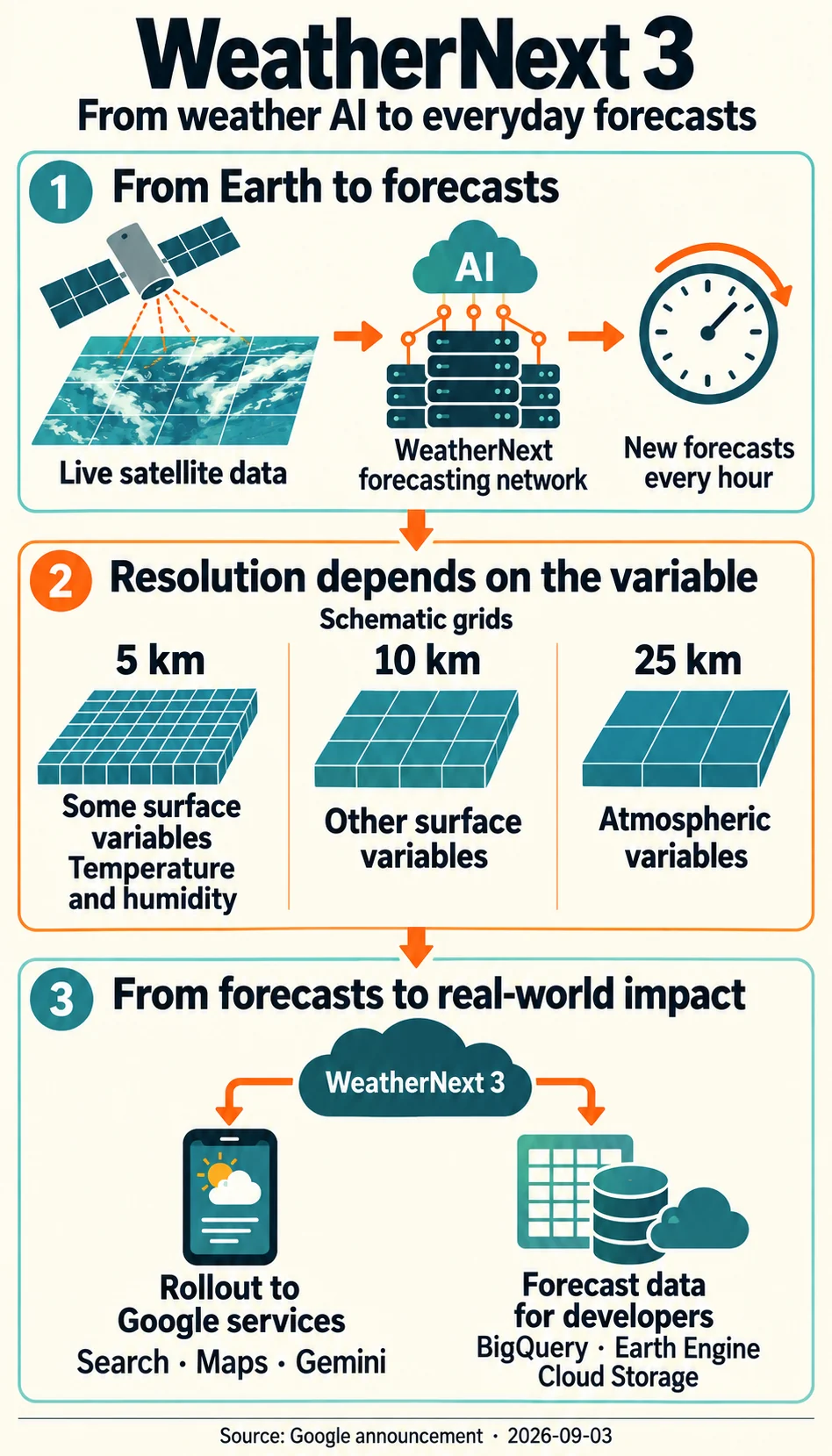
WeatherNext 3 incorporates live satellite observations and generates forecasts hourly. Its output serves both everyday weather experiences and developer data channels.
Grid size varies: some surface variables, including temperature and humidity, use 5 km; other surface variables use 10 km; atmospheric variables use 25 km. These are spatial resolutions.
Google announced rollout to Search, Maps and Gemini on September 3. Developers can obtain forecasts through BigQuery, Earth Engine or Cloud Storage.
Important additions and corrections
Dates below mark changes to our coverage.
- Addition ·
Clarified the weather model’s resolution: 5 km applies only to some surface variables, with others at 10 or 25 km; resolution is not forecast accuracy.
- Correction ·
Withdrew the unsupported advice to adjust early, retaining the weather-model release as a source note.
Sources and notes
sources中文
Sources and notes
- Read the originalGoogle DeepMind blog · AIHOT featured
- Google official announcement
Retained summary and context
Live satellite data, hourly forecasts and finer surface grids are coming to Google’s weather services.
The 5 km grid applies to selected surface variables; others use 10 or 25 km. Finer resolution does not imply an equal gain in accuracy. These are official claims; we have not tested forecast performance or regional availability.
Sources and evidence · 2 links
Each link has a purpose and scope. Link counts do not establish independent confirmation; direct support applies only to the statements specified below.
- Google DeepMind blog original, carried same-story by Google DeepMind blog, AIHOT featuredDirect support
Read the September 3 official announcement for satellite inputs, hourly forecasts, 5/10/25 km variable coverage, app rollout and developer data channels. The old DeepMind URL redirects to Google Blog.
Limits: Verified the official description, not relative model rankings, independent accuracy, regional performance or account access.
Source timeline
- · Found this reading link via Google DeepMind blog, AIHOT featured.
Collection record
First discovered:
Collection and source publication have distinct dates.
Editorial record
Sources reviewed
· Beijing time (UTC+8)
Reviewed official materials to clarify purpose, changes and usage conditions, distinguishing source descriptions from untested results. Original publication and observation dates are retained; an editorial revision is not a new product release.
Sources and full record
This dates our review of the wording and sources, not a project release or product update.
Full record: before, after and sources (JSON)