AlphaSignal, AIHOT featured · Published 2026-09-09
Will wages rise with AI-driven growth? Three Anthropic scenarios
If AI makes the economy larger, do wages rise with it? Anthropic’s three scenarios for the United States in 2030 put economic output and knowledge-worker wages side by side. They do not always move in the same direction.
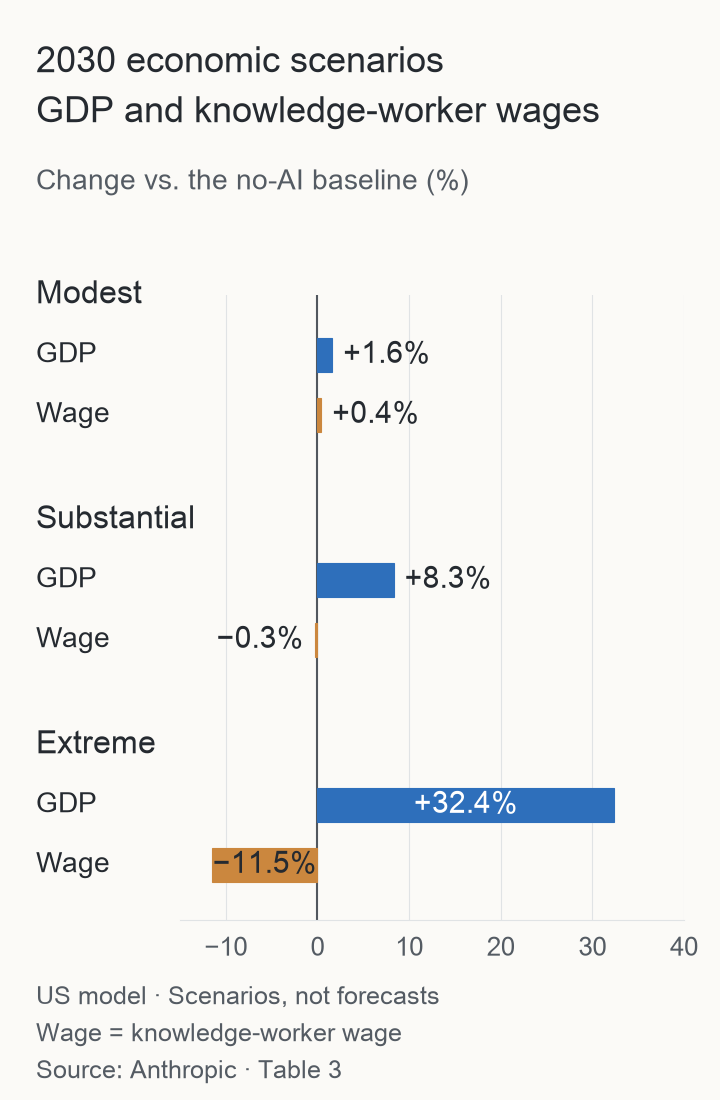
More output does not ensure higher wages
In the modest scenario, GDP is 1.6% above the no-AI baseline for the same year, while knowledge-worker wages are 0.4% higher. The substantial scenario puts them at +8.3% and −0.3%; the extreme scenario at +32.4% and −11.5%. A larger economy can coexist with pressure on this group’s wages.
Every value in the chart compares two states at the start of 2030: an AI scenario and the no-AI baseline. These are neither changes from today nor annual growth rates. The report’s knowledge-worker group covers management, professional, sales and office occupations.
An average wage leaves out part of the story
The extreme scenario contains another revealing pair: average wages are 9.7% above the no-AI baseline, but total labor income is only 0.5% higher. Average wages describe average pay among employed workers. Total labor income also depends on employment and the mix of occupations. The two measures answer different questions.
In the same scenario, labor’s share of total income falls from the baseline’s 60% to 45.2%. That makes the distribution question concrete: how much of the additional economic output reaches people through income from work?
The conditions behind the differences
The model breaks work into tasks. It separates what AI can do from how much is adopted, how much faster a task becomes, and how much can be done autonomously. It also considers the creation of new human tasks and the difficulty of switching occupations.
There are several steps between AI being capable of a task, a company handing it over, and a change in jobs or wages. The scenarios change several conditions together, so their different results cannot be attributed to one technical capability alone.
Follow the changes through everyday work
Our reading is to watch the tasks: which parts of email, documents, code and customer service move to AI, how existing workloads change, and which new tasks still need people. We will connect product developments with accounts of actual use. The related reading on Muse’s everyday assistant offers one concrete example.
These are conditional scenarios with no assigned probabilities. They concern the US economy and exclude rapid advances in physical robotics. They do not directly predict a person’s wages or China’s labor market. The official explorer linked below lets readers see how changing assumptions affects the results.
Sources and notes
sources中文
Sources and notes
Retained summary and context
Related sources may rely on the same material. Attention is not proof of quality, adoption or practical outcomes. Claims remain attributed to their sources. Collection is not proof of the claims or practical outcomes.
Sources and evidence · 3 links
Each link has a purpose and scope. Link counts do not establish independent confirmation; direct support applies only to the statements specified below.
This page keeps the original link and a short account. Follow the links below for the publisher’s full explanation.
Source timeline
- · Found this reading link via AlphaSignal, AIHOT featured.
Collection record
First discovered: ; added to the library:
Collection and source publication have distinct dates.