arXiv paper via the AlphaSignal daily · Published 2026-08-25
Why Agent Skills help: reusable steps still need adaptation
Skills turn prior execution experience into reusable procedures. The study separates having useful guidance, finding it and actually completing the task.
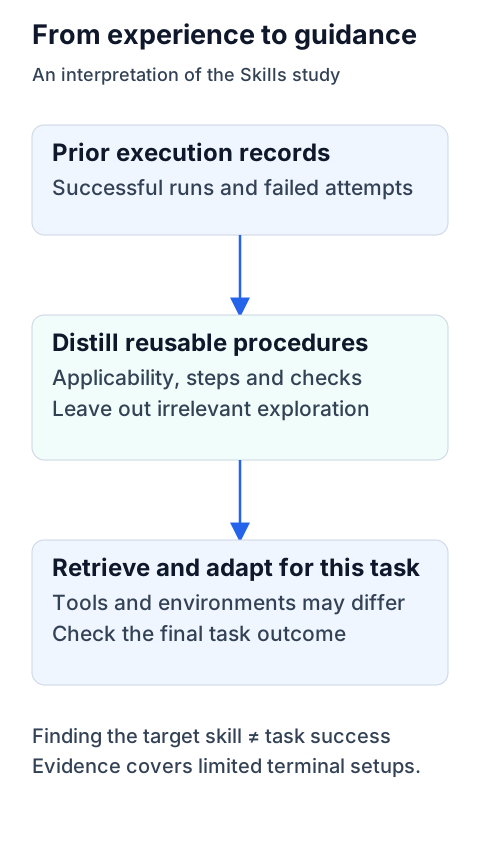
Compare the same experience in different forms
Researchers compared no prior experience, cleaned workflow records and SKILL.md distilled from the same records. The experiments cover terminal and tool tasks using a limited set of Codex and Gemini CLI configurations.
The corpus contains 8,135 normalized trials. Taxonomy development retained 238 valid labels from 240 open-coded records, followed by paired-trajectory analysis. The reported 65.7% procedural anchoring and 4.5% knowledge injection describe mechanism analysis, not exhaustive human labeling of all trials. Matched success averaged 6.06 percentage points above Workflow Memory.
Finding guidance does not finish the task
With candidate pools growing from 5 to 100, actual-use precision fell from 29.6% to 3.3%. This measures overlap with designated skills, not task success. Retrieval, explicit selection and real execution were independent experiments.
A practical implication is to describe applicability, essential steps and completion checks, then adapt them when the environment changes. This is our interpretation. Rigid commands or assumptions can still fail. The limited terminal-task settings and sampled taxonomy are not proof of universal gains across agents or open-ended collaboration.
Important additions and corrections
Dates below mark changes to our coverage.
- Correction ·
Clarified sampled taxonomy and paired analysis, and separated skill-use precision from task success.
Sources and notes
sources中文
Sources and notes
- Read the originalarXiv paper via the AlphaSignal daily
- Full Skills study
Retained summary and context
This is a study of limited models and terminal tasks, not proof of general gains for all agents. Mechanism labels use sampling and paired analysis; usage precision is not task success.
Sources and evidence · 2 links
Each link has a purpose and scope. Link counts do not establish independent confirmation; direct support applies only to the statements specified below.
Source timeline
- · Found this reading link via AlphaSignal daily.
Collection record
First discovered:
Collection and source publication have distinct dates.
Editorial record
Corrected
· Beijing time (UTC+8)
Clarified sampled taxonomy and paired analysis, and separated skill-use precision from task success. Event, discovery and collection dates remain unchanged.
Sources and full record
This dates our review of the wording and sources, not a project release or product update.
Full record: before, after and sources (JSON)